Showing posts with label Strathmore Artist Papers. Show all posts

Monday, August 17, 2015

The Fresh AiR Gazette

If you're like me you do your best to get as art out of your art adventures as possible. Before each voyage of discovery I spend weeks, sometimes months, establishing a daily routine of observing, sketching and painting -- of artistically living in the moment. When I'm engaged in one of my art adventures I try to experience place as much as possible, and squeeze every sketch, painting and journal entry of the unique local out of the limited time I have. (Of course, sometimes that looks, to the casual observer, like I'm holding a mug of tea staring off into space; but I guarantee the "record" switch is on.)

the layout design for page 1 of the new subscribers-only newsletter

In order to maximize my artistic experience at Zion National Park this year (and produce more artwork to share) I've decided to suspend most of my social media activities -- Facebook, Drawn to Life blog, and most email -- from early October to late November. 

I will stay in touch with my subscribers, however; sharing the latest artworks, trail adventures, journal entries, and links to exclusive preview time laps and step-by-step videos. And I'll do that via my new digital newsletter, The Zion Fresh A-i-R Gazette. Subscribers will receive a new issue of The Gazette each week while I'm on the road and in the park and, if the publication proves a success with readers, Zion will be replaced with the names of other parks as our adventures take us elsewhere in future seasons.

click on either page to view full screen

So, I hope you like the mock-up of Issue #1, and that you share it with friends and family, and (if you'd like to come along on our Zion adventure) that you subscribe. (Then just keep an eye on your inbox and I'll do the rest.)

Cheers! 
_________________________________________________________________________________

New Corporate Partner --

As noted in the test issue of The Fresh A-i-R Gazette, Strathmore Artist Paper has joined the team as my newest sponsor. Strathmore is renowned for their outstanding line of artist papers and journals, and I'll report in detail (including step-by-step field tests and demos) on the papers I'm testing for the Zion adventure in upcoming blog articles.   

Tuesday, November 11, 2014

The Intrepid Sketch Hunters: Strathmore Softbound Toned (or "Here There Be Monsters!")

I generally begin each new sketchbook/journal with an inspiring quotation.

The neat thing about sketching in nature (well, one of the many neat things) is that you always encounter surprises... if you're observant.

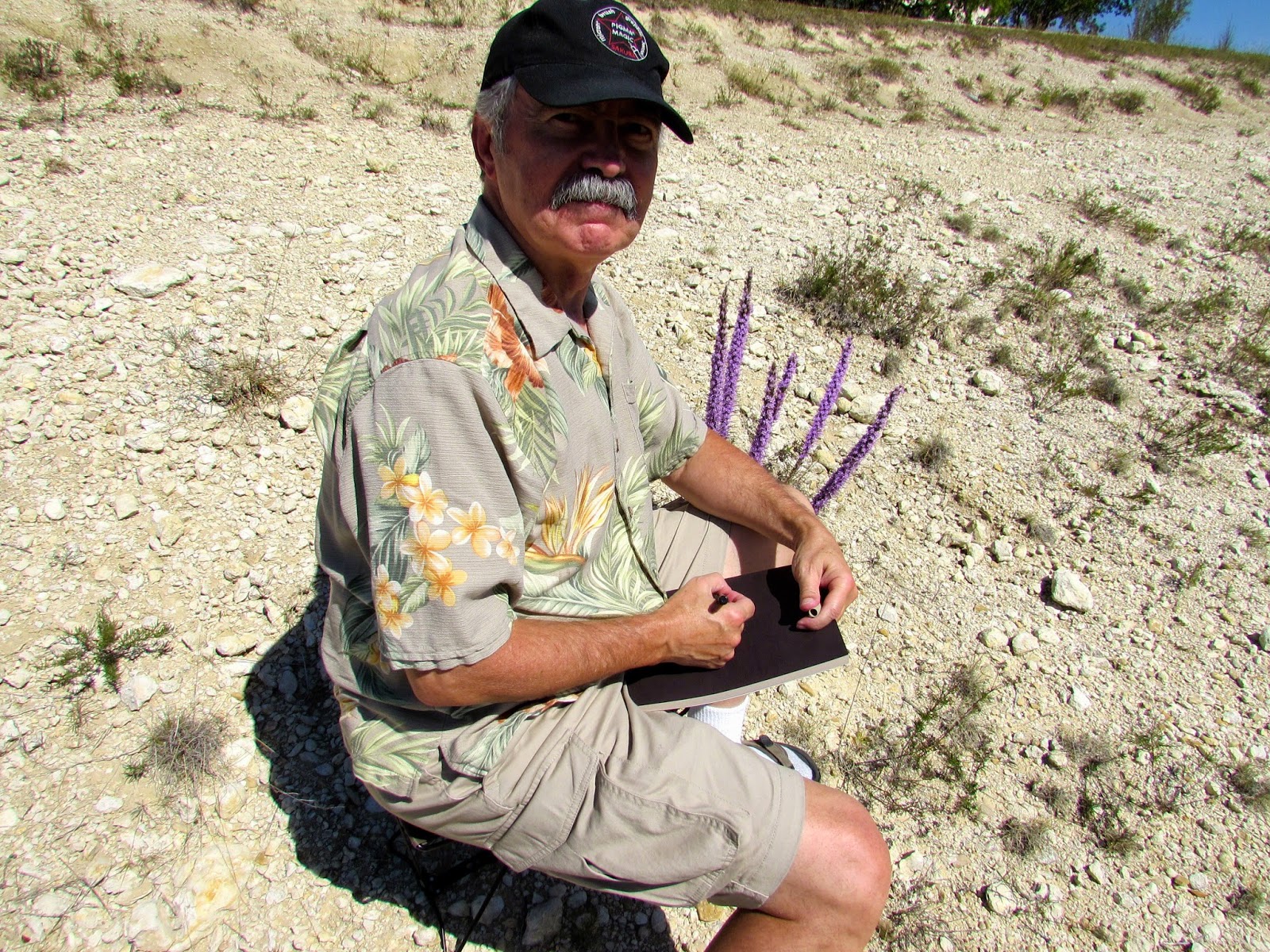
This week I'm continuing my exploration and evaluation of papers for journaling. And, whenever possible I'm doing it outdoors. (I know, it's a tough job. But, hey! somebody's got to do it.) The selected papers/sketchbooks will be joining me on a new series of field adventures in 2015.

Strathmore - Softbound

Strathmore is a name artists have been depending on for fine papers for 115 years. Earlier this year the company unveiled their new Softbound series. I have my eye on 3 journals in the series for use in in the 2015 project and am testing the 2 toned paper journals this week. (Watch for a separate field test and evaluation of the landscape-formatted Softbound Watercolor journal, and Strathmore's Series 500 Imperial watercolor paper in a future posting here.)

While artists still choose to create most of their drawings on white paper, it is also true that working on a mid-toned paper is the quickest way to produce a tonal/volumetric study of a subject. It's also true that, because works on toned paper aren't as common as those on white paper, toned paper has a visual impact, or "novelty", that white paper doesn't.

rendering volumes on toned paper is a breeze (if you simply 
remember to let the paper represent the middle tone)

Strathmore's Series 400 Toned Gray has a subtle vibrancy due to the inclusion of fine red and blue fibers scattered throughout its surface. The paper will work flawlessly with graphite or pen & ink. But, personally, I find a white and dark (either black or Indigo blue) color pencil particularly appealing for fast, bold renderings in the field or in the studio. Add to this the fact that the surface can easily stands up to repeated erasures without smudging or fraying and you have both a versatile and dependable tool.

toned paper is far more gentle on the eye when working with harsh reflected light 

toned paper can be invaluable for capturing unexpected or fleeting discoveries
(like this fossil I found at my feet while sketching on the fractured limestone above) 
_______________________________________________________________________


tip - putting down a light wash first will increase the "tooth" of the paper's 
surface and make it even more receptive for color pencils

As with the gray, the surface and sizing of the Toned Tan paper is ideal for graphite, color pencil, and/or pen & ink. The 118gm weight of the papers also means both are quite tolerant of repeated light washes, experience minimal surface buckling, and show no sign of fiber lift.

a drawing on toned paper can offer a visual experience that white paper may lack

______________________________________________________________________________________

And remember, when sketch hunting it always pays to be alert -- even when not actually sketching (otherwise you're likely to overlook "monsters").

here there be monsters! 


Wednesday, February 5, 2014

Sneak Peek 2 (Blown Away!)

"Life is what happens to you while you're busy making other plans."
                                                                             -- John Lennon


Well, sometimes reality steps in and throws us a curve ball when we least expect (or need) it. But, if we're "going with the flow" we can try to take it in stride and use it as a wonderful opportunity for a little "creative problem solving."

My "plan" for Lesson 4 in the Back to Basics workshop originally called for an outdoor demonstration -- with a sculpture of Mark Twain as my subject and the afternoon sun as our light source. Unfortunately, Nature decided to throw in a brisk breeze as a little challenge. Our in-camera mic lacked noise cancellation, and both the tripod and drawing paper were buffeted by the gusts.

Oops! I was so focused on the wind that I forgot I was wearing sunglasses.

My camera person added weight to the tripod for added stability (see both clips). My sound engineer added a portable noise-cancellation system to our equipment inventory. And I experimented with some dubbing during the initial editing. (Although, without an ambient sound bite, that wasn't completely satisfactory.)

"It was quiet... too quiet!"

So, creative solution: do an indoor portrait demonstration video for Lesson 4 (already underway) and shelve the Mark Twain video project till the sunshine/warm temperatures/calm winds return. (Watch for the latter as a possible "bonus" video in March.)

_____________________________________________________________________________

A few words of inspiration from the delightful Mr. Clemens --

pen & ink on Strathmore Series 400 Calligraphy laid paper

Monday, January 27, 2014

Sneak Peek (A Behind-the-Scenes Look at the Making of the "Back to Basics" Workshops)

our Lesson 3 subject (just as the clouds were stealing our light)

Producing an online workshop might best be described as "organized chaos": there's the logistics -- not only of drawing and sketching materials, but cameras, lighting, video editing equipment, and so on; there are lesson plans to write; weather forecasts to consider; shooting schedules to draw up; transportation to arrange; hours and hours of raw footage to edit; and deadlines to meet.

discussing materials options on camera

Fortunately, Texas is blessed with some remarkably mild winter weather (punctuated with brief -- occasionally dramatic -- periods of the nasty stuff.) So, while much of the northern hemisphere is shoveling snow, I have the option of alternating in-studio lessons with on location.

 
discussing a shot                                                            between takes 

Location shooting has involved scouting outings to find visually interesting subjects, to determine the best time of day to shoot (for the lighting), and to identify potential filming issues (for example, nearby construction or area traffic that will reek havoc on sound recording and necessitate time-consuming voice-over recording in the studio.)

scouting possible locations in December...

...when the light was perfect and the leaves were still on the trees


Studio lighting can be consistently maintained. So, it is possible for studio shooting sessions to run on for hours (sometimes late into the evening.) But lighting on-location is fleeting. Sometimes, by the time the crew has set up for a shot fast-moving clouds have robbed us of our light (and shadows.) And natural light is never consistent enough for more than two or three hours of filming on any given day. Often we return to a location 2-3 times to maintain consistent shadow patterns in the drawing and throughout the video.


a pair of "continuity shots" assure us that we'll be able to reestablish the 
same position and angle for follow-on shoots 


Of course, there are the unexpected occurrences that pop up too, incidents that either infuriate or leave the entire crew laughing wildly -- like the clueless driver who deftly navigated his pickup truck through a barrier of traffic cones during our second Lesson 3 shoot at the Fort Worth Japanese Gardens, pulled up between our film crew and the gate house I was obviously drawing, ask me for directions... to the Japanese Gardens!

I've written and illustrated four multi-page Instruction Sheets to supplement the lessons we'll be running in March.

annotated illustration for a lesson handout

Editing the Hi-Def raw footage has involved a lot of late nights (when it doesn't conflict with daylight shooting schedules.) I carefully went through hours of video clips (over 20GB of usable clips and uncounted quantities of rejected files) to create the final 19 minute, 16 second Hi-Def film for Lesson 1 (plus twice that for the two Lesson 1 "bonus" videos.) And, undeterred, I turned around and created a 34 minute, 53 second "blockbuster" on tonal drawing for Lesson 2.

an over-the-shoulder shot of a compositional framing demonstration

All-in-all though, we're having a delightful, highly productive time. And I hope you'll join me March 10 when the first lesson will go live on Strathmore Artist Papers' online workshop page. (And don't forget: participation is free, but registration is required to access both the free workshop downloads and the workshop chat room -- where you'll be able to share your work, ask questions, and mingle with your workshop classmates... and me.)

an  illustration for another instruction sheet

Hope to see you there!

____________________________________________________________________________

Postscript -- Any time a workshop (live or online) involves working with a new line of papers or tools I like to take a little time up front to do some hands-on familiarization. So, before getting under way with the workshop shooting sessions I treated myself to a little one-on-one with Strathmore's "Skills" series -- exploring how far I could push the papers, and what kind of results I could expect to consistently achieve. 

fountain pen and watercolor over Micron pen 

Given how well it handles mixed media (including light watercolor washes) and its high page-count (100 sheets), the 5.5in. x 8.5in. Series 200 "Skills" Sketch tablet could be quite serviceable as a pocket field journal.   

Tuesday, December 24, 2013

Back to Basics (Strathmore Online Workshop -- March 2014)


WIP image from a bonus video we shot at the Fort Worth Botanical Garden last week

Hi everyone!

As you may recall, I usually spend the winter months re-honing my drawing and painting skills in preparation for the New Year's art adventures (both near and far afield.)

This year Strathmore Artist Papers has invited me to share that experience with others and I have happily agreed to teach a four-lesson online workshop for them in March. My film crew and I are already busy shooting the lesson videos (and several hours of "bonus" video that I think you may enjoy.)

some (but not all) of the papers I'll be working with

We have a number of papers we'll be working with and an extensive range of media and techniques to explore. (And, best of all, registration is FREE!) So, I hope to see you there and, please, feel free to bring a few friends. 

Oh, and watch for a series of "behind the scene" and "making of" articles here, too, as we lead up to the beginning of the workshop. It should be fun!