Showing posts with label fountain pens. Show all posts

Tuesday, April 15, 2014

Pen Kimonos

As anyone who has followed my blog or visited my website can attest, I am a penman.

Don't get me wrong. I love working with pencils too, and I wouldn't start an adventure without one (or more) of my pochade boxes. But I'm certainly fascinated (my wife would sometimes say, "obsessed") with fountain pens; I like their history, their technology, their feel and appearance, and most of all I like drawing and writing with them.

the current selection of pen kimonos -- all one-of-a-kind!
Top Row: 1.Teapots, 2.Tropical, 3.Cowboy Boots, 4.Artic Wildlife
Bottom Row: 1.Sunflowers, 2.Fishing Lures, 3.Boots Too, 4.Teacups

Some folks (especially those with large collections) may opt to keep their fountain pens in display cases, where they are safe from dust and grime. But I like to have at least two in my day bag whenever I venture out of the house. Unfortunately, that raises the possibility of damage from the aforementioned dust, grime, and even dings, dents and (every penman's nightmare) drops.

my 24-year-old "daily carry"

Fortunately for me, my wife is creative in a wider range of media than I and came up with a lovely (and equally functional) solution several years ago -- the pen kimono! Using attractive fabric patterns for the pouch exterior, the "kimono" has quilting (to protect against shock or damage due to accidental drops) and two compartments (to prevent abrasions that would otherwise be caused by rubbing up against one another.

I've been carrying the original for over 24 years with no sign of wear or tare to pens or kimono!

applying bias-tape to one of the kimonos

Now my daughter (whose is quickly assimilating the artistic interests of both of her parents) has partnered with my wife to produce a new line of handmade one-of-a-kind kimonos for other fountain pen fans (a bargain at just $12 each!) If you count yourself among this group and see something you like, PM us. Please specify the kimono you're interested in (for example:.e member that these are one-of-a-kind. So, it's first-come-first-served. We invite queries regarding designs that have already sold, and will be happy to let you know if a specific fabric is available for special order.)

freshly ironed and ready to go! The difference between this one (which 
my daughter made for herself) and the two "Cowboy Boot" kimonos shown 
in the top photo demonstrate the one-of-a-kind nature of these pen carries.

Shipping within the U.S. is a flat rate of $6. If you live outside the U.S. PM us with your city and country for a shipping quote. All shipping comes with a tracking number. Please note that, in order to protect your financial security, all billing is done through PayPal. (No PayPal account? Not a problem. PayPal is happy to accept all major credit cards.)

Cheers!

Monday, May 6, 2013

Tricks of the Trade -- How to Fill A Lever-Filler Pen (Completely)

fountain pens that lack a means of viewing the ink reservoir can leave you wondering about your ink supply 

Many of us have "discovered" the very affordable NOS Eversharp Symphony fountain pens (and their delightful 14k flex nibs) that have recently become available. But several questions have come up in some of the online chat rooms: how does one go about properly filling a lever-filler? How can one determine if it is full (since the pens' reservoirs lack clear inspection windows)? What is the ink capacity of the sac? And how can users carry extra ink (without making a mess) when journaling afield?

Well, not knowing the answer to any of those questions, I thought I'd try to learn the answers and share my findings with you.

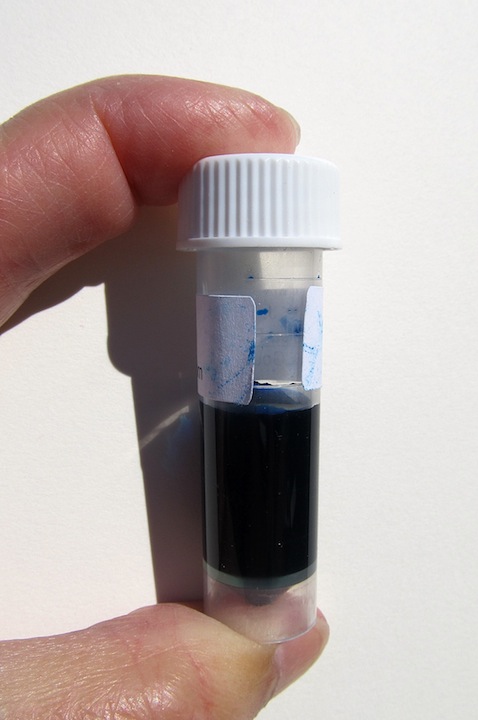
Goulet Pen Company sampler ink vials

The last question (how to carry extra ink afield) was the first one answered  -- thanks to the folks at Goulet Pen Company. It turns out Goulet Pens routinely ships ink samples to their customers using self-sealing vials. These vials have an inverted cone base (which facilitates getting just about every drop out) and are calibrated in milliliters (with a 6 milliliter capacity). Goulet Pens ships these ink-filled vials in a zip-lock snack bag for added safety and I do the same when I carry one or more on sketchcrawls. However, I have yet to experience a leak of any kind from one of these vials. A pack of 10 empty sample vials (with blank stick-on labels) will cost you the princely sum of $2.95 plus shipping, or you can order a few ink samples and just rinse out the vials when they're empty.

being a visual person, I find a how-to video much more useful than step-by-step text

Maximum fill of the lever-filler was achieved through trial and error, but the method that I've found works best for me is as follows --

1. Raise the filler lever till it is perpendicular to the pen barrel.
2. Insert the nib into the ink bottle until it is completely submerged.
3. While keeping the nib completely submerged, slowly lower the filler lever back to the barrel.
4. Keep the nib submerged in the ink for a full 10-count. (This may sound like a long time to wait for filling to be completed but I actually got this time recommendation from a vintage Sheaffer instructional film.)
5. Remove the pen from the ink bottle and carefully wipe down the nib and feed with a clean, absorbent rag.
6. Holding the pen horizontally, gently shake it. (I do this over a sink, just in case.) If you feel or hear a sloshing move on to step 7. If there's no sloshing you're full.
7. Holding the pen with the nib up, SLOWLY pull the filler lever out again. You should observe air bubbles being blown out the nib's breather hole as remaining air is expelled from the sac. If ink appears around the base of the feed (where it meets the barrel/section) pause a moment and let it settle back into the sac. (My personal experience is that the Symphony's sac is only half filled by steps 1-6 and I gradually raise the filler lever back up to the full perpendicular position during step 7.)
8. Reinsert the nib into the ink bottle and repeat steps 3 through 5.
9. Your lever-filler pen is now completely full!

what you're watching for during the 2nd filling

3.5ml of ink -- enough for 5-7 days of everyday use

Sac capacity -- using the calibrations on the Goulet Pens ink vial I determined the sac capacity of my Eversharp Symphony to be a very respectable 1.5 milliliters -- about 1.5 times that of my TWSBI Mini and about three times the capacity of the average fountain pen converter unit. Not bad!

J. Herbin Bleu Pervenche on Rhodia vellum paper -- yummy! 

Cautionary note: You may wish to avoid squeezing every last drop into your pens (especially on cool days) as you may risk a situation in which the heat from your hands (or your chest if you carry your pen in a shirt pocket) causes the ink to expand and escape from the filled-to-the-brim pen.


Happy sketching!

Thursday, March 28, 2013

Of Fountain Pens and Dinosaurs


For those of us who use fountain pens regularly -- whether for correspondence, art, calligraphy, or business -- it is inevitable that at some point someone will (or has) asked, "Why are you still using that old dinosaur?" (or words to that effect). Well, while researching pen nibs recently I learned that there actually is a connection between fountain pens and dinosaurs!


Most of us are already aware that, in order to reduce wear and to provide a smooth writing experience, nib manufacturers have, since 1834, tipped our nibs with a tiny ball of iridium during the manufacturing process. This hard metal is a rare member of the platinum "family" of metals. In fact, it is so rare that it is found primarily in the Earth's core (where, of course, we can't get at it), in meteors (ditto), and in a thin layer of the Earth's crust called the K-Pg (formerly known as the K-T) Boundary. What, might you ask, is the K-T Boundary? Well, it is the thin geological layer (usually no more than 1 inch/3 cm) of pulverized minerals that lead Walter Alvarez and a group of like-minded geologists to postulate that a meteor measuring approximately 6 miles in diameter (and containing a sizable amount of iridium) struck the Yucatán Peninsula some 65.5 million years ago with a force roughly equal to that of a one million megaton bomb. (I know, that's way too many zeros for me to get my head around too.) The result, however, was: A) the extermination of the dinosaurs, B) the creation of deposits of iridium in what would become known as the K-T Boundary, and (possible) C) the tip of my smoothest-writing nib.


So, the next time some wise guy unwittingly asks you, "Why are you still using that dinosaur?" you can respond, "Say! Do I have a story for you!"

Dr. Walter Alvarez, who led the team that first identified the K-T Boundary. 

Parting esoterica (or "six more degrees of separation"): I never heard of Walter Alvarez and his work while I was an undergrad at California College of Arts & Crafts -- even though he was a celebrated professor at the school just down College Avenue from us (that would be UC Berkeley). But I did know of his great-aunt, Mabel Alvarez, and her work (as an avant guard California artist and member of the "Group of Eight"). The world is such a finely interwoven fabric, don't you think?

Mabel Alvarez self-portrait, 1923

Cheers!    

my son and his "pet" raptor

Monday, December 31, 2012

Snail Mail, Vintage Post, ... and Thou

(pen work by Charles Dana Gibson)

For the past decade rekindled interest in fountain pens has been steadily growing. People who have grown weary of the high speed, never stopping - never pausing, race toward the Future that is the 21st century pace of things just might be robbing them of something: the experience of the beauty and wonder of the Here and Now, the experience of Life.

if you can't think of enough to say, a favorite verse,  

... a sketch, or an inspirational quote may be just the thing


Some artists who have felt a disconnect with the impersonal digital word of the machine have found limitations in the world of pixel-based images and have renewed their acquaintance with old, almost forgotten, friends -- pens, pencils, and paper.

you can't put a ribbon around a bundle of emails 
(I also bought my wife a large, decorated German tin for her cards & letters) 

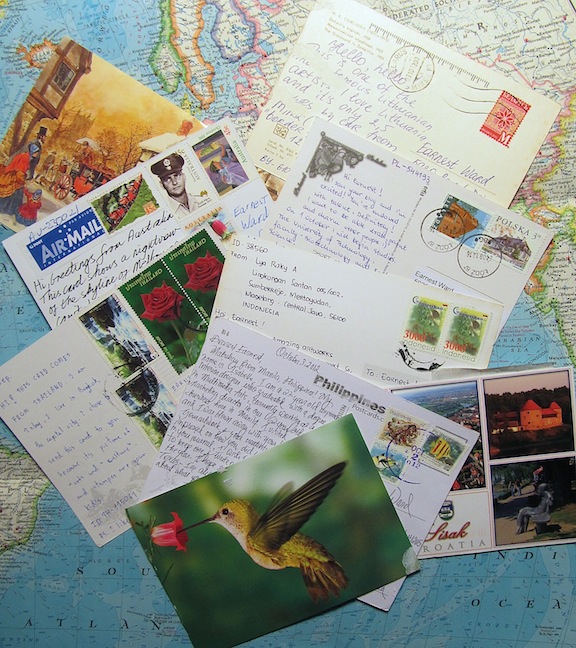
Some who have recently renewed their acquaintance with fountain pens -- not being satisfied to merely collect them as relics of another time, or as commodities -- have discovered that they can be invaluable allies in Slow Living -- a philosophy that grew out of the Slow Food movement in Europe that builds on the premise that we can do less and experience more (very much like the Arts and Crafts Movement's emphasis of Quality over Quantity). Snail mail has made a comeback and devotees are once again taking pen in hand to reconnect with friends, relatives, and (through groups like the Fountain Pen Network) with new pen pals in faraway places. Concerned you can't think of enough to fill a letter? Start out with postcards; they're fast and easy. Groups like Postcrossing will be happy to match you up with postcard pen pals from around the world (free of charge).

Russia, Poland, Thailand, Australia, Croatia, the Philippines, Argentina, 
Indonesia, the UK -- less than two months worth of postal globetrotting (fun!)

And another interesting phenomena has arisen; A) someone discovered that (at least in the United States) unused postage stamps never expire, and B) there are enough vintage postage stamps on the market that they can actually be had for a reasonable price (sometimes for little more than their original face value).

vintage stamps can be found in various sizes, colors and themes 


these sets, and others, are available from Etsy vendors, such as Verde Studio


a hand-written letter like this in my mailbox wins hands down over my digital inbox anytime

So, if you have a fountain pen (or maybe even a dip pen) with an expressive, nice-writing nib -- And if you have the skill to address the envelope in a fine Spenserian or Copperplate hand -- why not indulge yourself in some pen-friendly stationary, dust off your old address book, sit down and write to that best friend from high school or college you haven't seen in years. (Or your mom -- when is the last time you wrote your mom?) Add a few reasonably priced vintage stamps. Seal the envelope with sealing wax and your old signet ring. (There are even new polymer sealing waxes that are "postal proof".) And let Ben Franklin's postal service do the rest. The results could very well be magical!


this year I even took time to renew the acquaintance of ol' Saint Nick
(everyone likes to receive a hand-written letter!)

Postscript, if vintage stamps aren't available in your area and those available on Etsy are a bit too pricy, just visit your local post office. They're certain to have a selection of new and commemorative stamps (my current favorites are Miles Davis, Edith Piaf, and -- my wife's favorite -- a very dashing Gregory Peck) for you to choose from.

_____________________________________________________


Giveaway #4:
You say your handwriting is atrocious? You say you were born in the 90s and have no idea how snail mail works? Well, that sounds like an excuse for another grand prize giveaway to me! This time our lucky winner will receive a copy of  Diane Maurer-Mathison's beautifully illustrated how-to book, The Handcrafted Letter. So, sign up by clicking the blue "join this site" button on the right (if you haven't already done so), and leave a comment including the words "Handcrafted Letter" below between now and Friday, 11 January. The winner will be selected at random and notified via personal message on Saturday, 12 January. And the results will be posted here Sunday, 13 January.

not quite new, but gently used

Giveaway #5:
You say you'd love to send hand-written letters to friends and relatives but you don't have a fountain pen? You say your discretionary funds are too depleted to indulge yourself? Well, Santa just may have left a little something under my tree with your name on it! In the spirit of the Santa Season I've got a Burmese Ruby red Noodler's Ahab that will be forwarded to one lucky would-be penman (or woman). So, to enter the drawing be sure to join this site (see instructions for Giveaway #4 above) and leave a brief comment about why you would like to win this pen. Dates are the same as for Giveaway #4.

Please note: participants are welcome to leave a separate comment for each of the giveaway prizes, but a separate winner will be selected for each prize.

Good luck!

Parting words (a little visual reminder from the cast, and director, of one of my favorite feel-good films that not so long ago everyone wrote beautifully...)

(...and everyone carried a fountain pen)


Tuesday, December 4, 2012

Tools of the Trade #5 -- Ink Spots (The Series)

no, not those Inkspots (but if you don't know their music you owe it to yourself to go here) 

Over the weekend I received a delightful package from the folks at The Goulet Pen Company. The packages contained an assortment of 14 fountain pen ink samples (to add to my collection of 18 other fountain pen inks I already had), a business card and book marker -- a really nice book marker (one is included free with every order, and that's quite appreciated by those of us who are also bibliophiles), 2 ink syringes... and a grape-flavored tootsie pop miniature (in a blue that appears identical to that on the company's logo).

yummy!

I am beginning a new series of articles reviewing some of the inks that have been made specifically for use in fountain pens -- mostly modern day inks, but occasionally a bottle or two of vintage ink that I've come across during my travels and adventure. Each article will focus on inks of a specific color from several different manufacturers, will evaluate the selected inks' specific color/hue, intensity, shading, flow, drying time, water resistance, propensity for staining and creeping, and light fastness*.

FYI, I'm told that's Diamine Presidential Blue in the Goulet logo "blotch"

This week (in the way of a salute to the crew at Goulet) I will start with blue, eight blues to be precise: Waterman Florida Blue (vintage), Parker Quink (vintage), Sheaffer Blue (vintage), Campo Marzio Roma Azul Marino, Pelikan 4001 Blue, Pelikan 4001 Turquoise, J. Herbin Bleu Pervenche, De Atramentis Steel Blue, Levenger Cobalt Blue, and Sheaffer Peacock Blue (vintage).


lightfastness chart (updated Dec. 7)

For the light fastness test I have created a panel on Arches 140 lb./300 g/m2. The panel has been cut down the center and the right section will be place in a north-facing window for the next six weeks (* that's intense, mostly cloud-free north Texas sunlight). I'll also post a weekly update here to document what, if any, effect the UV exposure is having.

Vincent Van Gogh's sketch of fishing boats

While I was in grad school one very memorable conversation I had with one of my art history professors revolved around Vincent Van Gogh's gorgeous pen and ink drawings. I went on about how I loved the effects Vincent achieved with his homemade reed pens, and how beautiful his brown ink was... and I was absolutely floored when my instructor said, "Well, you know that ink was actually purple when he drew them don't you?" That was the day I learned that not only were some dyes subject to fading (fugitive) when exposed to UV light but that some dyes also change over time simply because of their chemical composition.


drying time/smudge chart (updated Dec. 7)

For the drying time test I drew a chart with a series of lines for each ink. The ink lines were then checked to see if they would smear at intervals of 1, 5, 10, 20, 30, 45, and 60 seconds. Pelikan Turquoise and Sheaffer Peacock Blue had the shortest drying times at under 10 seconds (very useful for left-handed writers, like my wife and son, who want to reduce the likelihood of smudging) while the J. Herbin ink had the longest drying time at just over 30 seconds. Four of the inks (Parker, Sheaffer, De Atramentis, and Levenger) shared drying times of just over 20 seconds, while three (Waterman, Campo Marzio, and Pelikan Blue) were just over 10 seconds.   

dye separation in one re-wet and mopped ink

Most fountain pen inks are made up of water soluble dyes rather than pigments, and many of these inks are a complex mixture of several dyes -- some more soluble than others. The photo above shows a tissue that was used to blot an unknown brownish-purple ink that had dried up in a vintage rotting Art Pen. (Note that there appear to be at least four different dyes in this one ink!

separation chart (before)


separation test (after) (updated Dec. 7)


To do the dye separation test I first created a chart on Stratford 400 series calligraphy paper. Next I dripped water on the dried ink, being careful not to disturb the ink with the brush. I observed that the Waterford, Parker, Sheaffer, and Campo Marzio all lost considerable intensity after re-wetting as much of their dyestuff was absorbed into the paper's fibers. I also noticed that the Campo Marzio shifted toward lavender after re-wetting and, while the Levenger lost none of its intensity it did develop a decidedly purple ring after re-wetting. (I added Sheaffer Peacock Blue -- another Turquoise -- to the separation test on Dec. 6, with an undiluted drop on the left and a re-wet dot on the right. Like the other two turquoise, there was no noticeable color separation and intensity remained very strong.)


separation test (reverse)

On the reverse side of the separation test chart it could be readily observed that red dye had separated from the blue and soaked into the paper from the Parker and Campo Marzio Roma. And, while there had been no bleed-through during the initial inking, the Pelikan Turquoise, J. Herbin, De Atramentis, and Levenger all soaked through after the re-wetting.

In conclusion, Levenger's Cobalt Blue was the hands-down winner for sheer concentration of dye in their formula. (In fact, Levenger users could very likely increase the color intensity of this ink by expeditiously experimenting with the addition of small quantities of distilled water to increase the ink's transparency.) The J. Herbin, Pelikan Turquoise, and vintage Sheaffer Peacock Blue tied for color saturation and intensity straight out of the bottle. The De Atramentis offers fantastic shading -- from a brilliant try blue when applied thin to near-black when thick (a great candidate for wet nibs and signature pens). And the old classics (Waterman, Parker, Sheaffer Blue, and Pelikan Blue) offer flawless/skipless service and reliability for fountain pen lovers looking for a more traditional (maybe slightly "quieter") blue.

The J. Herbin appeared to be slightly more viscous in the sampler bottle/pen than the others. But none of the inks in this test batch gave any indication that they would be a staining or cleaning problem (think Baystate Blue maybe) for pen owners. 

At the end of next week's article, and each week for the next six, I will post a photo and progress report on the blue fade chart. Look for another ink review (on reds, oranges and browns) in 2-3 weeks. (I'll be alternating the ink reviews with other subjects and themes.) In the meantime please feel free to post any questions you have regarding this ink selection, or specific inks you might like to see in future reviews.

Cheers!


I thought I'd close with another piece of retro technology (watch closely and you can see the drive mechanism at work on the right)

Sunday, November 4, 2012

A Salute to the "Little People" and Django Reinhardt


OK, being new to video demos I was bound to make a few mistakes my first time out -- and several of you were kind enough to let me know what I needed to do to get it right. So, here's attempt No. 2 (another page from the upcoming calligraphy book, this time shot from the left). Hope you like it (and, if so, that you'll share it with a friend).

Cheers!


Oh, the soundtrack is an homage to Django Reinhardt and the soundtrack of my favorite movie from 2011. (I thought it went well with the tempo of the demo. What do you think?)