Saturday, October 24, 2020

Video Snapshots


I've begun creating and posting a series if short videos (I call them "Video Snapshots.") to my Instagram account recently. Each video runs 13-60 seconds in length and provides a step-by-step insight into my working process on a painting or drawing (or, in some cases, a scrolled pan of an elongated drawing or journal entry.)

To date I've posted 7 snapshots. (If you don't currently have an Instagram account, you can view the first 6 on my DrawntoAdventure YouTube channel.) And, going forward, I'll try to post a new short to Instagram every 3-4 days.

Once I have a steady following I hope to expand the offering by adding slightly longer (up to 10 minutes) IGTV demo and instructional videos to the mix. 

So, take a look. And, if you like what you see be sure to "follow" me on Instagram.

Oh, if you have an idea for my future videos (Want to see instructional videos? Demos? Studio work? Plein air? Painting? Drawings? Journaling?) let me know in the comments below and I'll see what I can do.

Thanks!

Monday, October 12, 2020

Art in the Age of Covid

 Like so many others, I've been experiencing an increasing level of stress since the onslaught of the global health crisis. Thanks to the internet and 24/7 news feed (which was SO accurately described by one observer as the "Doomsday Scroll"), we are all bombarded during our every waking hour by a steady stream of political, social, and health crisis that most of us are powerless to resolve.


So, I've decided to join the growing number of people who are choosing to focus on the things that we do have some control over. I've deleted the news feed apps from my phone, stopped reading newspapers, stopped listening to radio talk shows, and stopped watching broadcast TV.

Instead, I've turned my attention to making art, fly fishing, and riding my bike (which frequently gets me to places where I can make art, or fly fish, or both.)

And - with this post - I'm renewing blog posting on a regular basis in hopes that these posts may prove helpful to others who are seeking a healthy, stress-free alternative to the current day-to-day grind.

I invite you to get comfortable, dust off your pens & pencils, get out your paints, and let's get started. 

To get things rolling (and get some rust out of the system), I decided to complete a couple of paintings from my Zion National Park series. First was In the Shadows (First Snow), 12"x12", oils on panel (above), followed by Along the River/Zion Canyon from the Temple, 9"x16", oils on panel (below). (And, if you'd like to see more works from this series, please visit my website gallery at http://www.earnestward.com/Earnest_Ward/Zion_NP.html )


In future posts I will share additional works, discuss art supplies & materials, offer suggestions on a variety of subjects and techniques, and demonstrate helpful step-by-step art-making processes.

As always, thanks for letting me share. And I hope to see you next time.

Oh, and if you'd like more frequent updates on what I'm up to, please follow me on Instagram! (https://www.instagram.com/earnestwardartist/ )

Wednesday, February 7, 2018

Up, Up and Away!

(Sorry 'bout that. Now you'll spend the rest of the day with the Fifth Dimensions song playing in your head.)

I haven't posted in quite some time - but it hasn't been because I have no plans for new wilderness adventures.


As a matter of fact I've been busy polishing the rust off my piloting and photo/video skills, having a blast (at least on the days that haven't been too cold or too wet), and planning my next voyage de découverte (to begin just as soon as we've settled into spring.)

So, once color starts returning to Mother Nature's cheeks expect to see my usual sketches and paintings of wild things and places supplemented with panoramic aerial photos and videos - beginning here in Texas with the spring wildflowers, but ending up wherever the wanderlust takes us.

Hope to see you there!

Monday, March 6, 2017

Uinta Chipmunk (A Step-by-Step Demo)

Anyone who has hiked up to Angels Landing knows that, while on the move, you spend a great deal of time watching the trail ahead of you. (After all, accidentally wondering off this trail can be VERY traumatic.) And, as you near Indian Lookout you start noticing something new flitting back and forth across the trail (and maybe coming inquisitively close to you if you sit down to take a break along the way.) This speedy little fur ball with the alternating burnt orange & white stripes that runs with its tail stuck straight up in the air is Uinta Chipmunk, and it calls the higher elevations of Zion Canyon home. And this week I thought I'd share a "pocket painting" step-by-step demo of how I went about painting this energetic little fella.


As with most of my Zion paintings, I began with a small pencil comp study on gridded paper -- discovering the light/dark patterns, selecting the format shape, and determining the compositional relationship.


Work now begins on the pocket panel I've selected for the job -- in this case a 5x5 Gessobord which I've pre-toned with Burnt Sienna (a little darker, and redder, than my usual Yellow Ochre) -- as I quickly draw in the key shapes & confirm the shadows. (Note that I decided to draw the chipmunk slightly larger than in the comp study, and eliminate part of the surrounding sandstone.)


Painting began with a quick roughing in of the subject and establishment of the first shadows in the surrounding Navajo sandstone -- working from the middle tone of the panel toward my lightest lights and darkest darks. (That is, at this stage I avoid using white or chromatic black.)


With the color/tonal areas roughly established in the chipmunk I continue to block in the shadows and secondary (reflected) highlights within the weathered stone -- paying particular attention to the cool/warm contrasts.


Value contrast is relative: lights will appear lighter as new darks are introduced; and darks will seem to get darker as new areas of light are applied. For this reason (and to allow me the freedom to "discover" new highlights and core shadows to the very end) I continue to hold my lightest & darkest colors in reserve.


Once all of the general shapes have been blocked in and the basic color patterns have been completed I turn my attention to the final details; fine tuning color, unifying form, and carefully selecting & applying the brightest highlights & deepest shadows.


SaveSaveSaveSave

Friday, February 24, 2017

All Things Great and Small

As one might expect, most of my time in Zion Canyon was focused on the geological giants, the brilliant color effects, and the ever-changing lighting. But, occasionally, I found time to gaze in wonder at the little things -- the flora and fauna -- that call the canyon home.

Two simple (and ever so beautiful) examples: a Western Bluebird that perched on the Grotto bus stop sign while I awaited the shuttle one morning; and a Sacred Datura in full bloom that I discovered near the Junction bus stop one afternoon. (In both cases, not while I was going somewhere, or looking at something else, but while I was waiting -- when I took the time to look at the micro-world about me and was open to new discoveries.)

Western Bluebird, 5"x5", oils on panel

When I am going no place in particular (or when I'm en route to somewhere in particular) I often carry a set of "tools" with which to capture the unexpected, the serendipitous: a pocket full of small Gessobord panels (I call the results "pocket paintings") with my small (ultra light weight) pochade box; and a sheet or two of 3.5"x5.5" watercolor paper (actually heavy ivory-colored, deckled "Verge de France" cards by G. Lalo) tucked away with my field notebooks, pens & watercolors in my daybag.

Sacred Datura, 3.5"x5.5", w/c over pen & ink

I never know when Circumstance will present me with an opportunity that calls for me to use one or the other; but I usually end up with a delightful keepsake of a memorable mini-adventure when she does.

On a footnote: the Sacred Datura is indigenous to dry areas of the North American west and southwest, and is highly poisonous to humans and livestock alike. However, several of the First Peoples of the region have discovered both medicinal and religious uses for this fragrant bloomer.

Monday, February 13, 2017

Bend in the River - The Virgin River, Late Morning (A Step-by-Step Demo)


As with each of my paintings from Zion this image began with a decision about format (square? rectangle? elongated rectangle? horizontal? or vertical?) and then a quick compositional study in pencil on gridded paper.

Actually, this particular view had initially suggested an elongated horizontal format (previously posted) because of the width of the canyon at this point. But I was also taken with the verticality of the river and, so, decided to do a second composition.


As mentioned in last week's post, I began most of my Zion panels with an undertone of Yellow Ochre (an allusion to the overall warm tones of the canyon's stone wall) and then painted in the sky. The clouds set low in the sky at the far end of the canyon are tinted by the pink Navaho sandstone dust.


Next came the warm tones of the distant west wall of the canyon and the low intensity greens of the desert foliage just below the wall (which introduced a hint of the complimentary contrast to come.)


Working from background to foreground, I next moved to the east wall of the canyon and the foliage just beneath it. Both were, for the most part, still in shadow. But there were splashes of highlight to be seen within the foliage.


The meandering river was added next - pale as the sky itself where it was in direct sunlight, more intense within the shadow of the unseen canyon wall that towered above us to my far left.


The middle ground foliage tumbling down to the river's edge came next; again in deep shadow except for the faint warm highlights provided by indirect light reflected of the west canyon wall to the right. As I moved into middle ground (and eventually foreground) I began to apply the paint more thickly with a more aggressive, painterly brushstroke that that contrasted with (and complemented) the crisper edges of the dominant shapes.


An area of mostly warm red sandstone (with sparse patches of greenery) completed the foreground in the lower left & lower central portions of the painting. 


The distant middle ground foliage and trail leading toward Walter's Wiggles & Angels' Landing were blocked in next - being careful to keep contrasts subdued because of the bright direct sunlight and atmospheric haze.


The bright sandy riverbank in direct sunlight was added next. The dry water channels on its surface were hinted at by subtle shadows & tonal variations. 


The foreground riverbank was in deep shadows of violet, crimson violet, and blue violet. Core shadows of Phthalo Blue and reflected secondary highlights of crimson pink were also added to the segment of the river in shadow.


And the final stage of the color study consisted of blocking in the intense darkness of foreground foliage in the overhanging canopy, subduing the intensity of the shadowed Navajo sandstone at the bottom - and adding my signature. The finished work measures 24"x12" and was executed on Ampersand Gessobord with Gamblin Artists' Oil Paints.

I hope you've enjoyed this demo (and maybe found it a bit informative) and that you'll join me again next time.

In the meantime, I hope the weather where you are lets you get out and paint (or sketch.)

Cheers!


Thursday, February 9, 2017

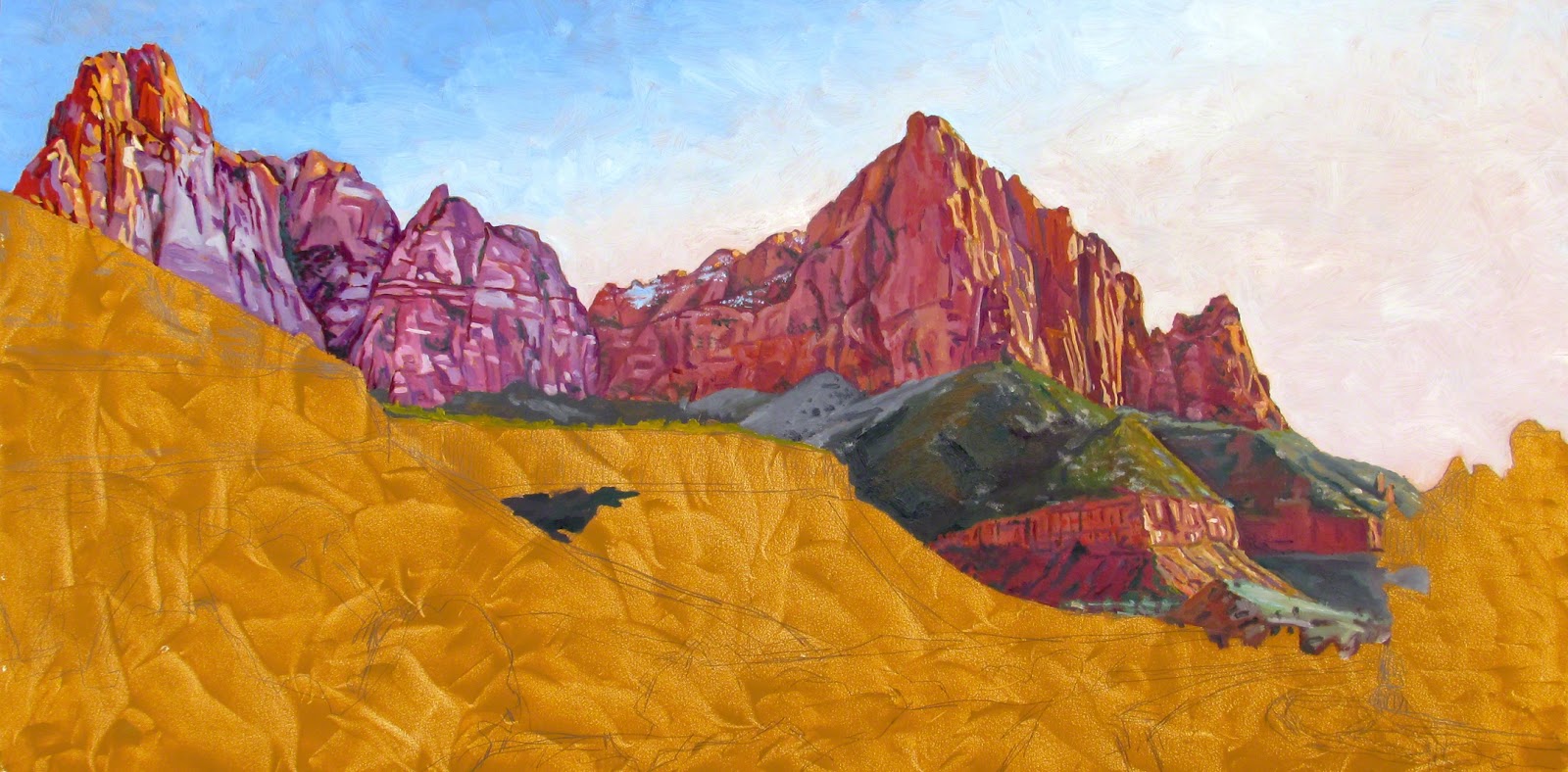
The Watchman, Late Afternoon (A Step-by-Step Demo)

Rather than simply post another finished work in my Zion series, I thought I'd share a little insight into my work process with a step-by-step demo this week.


Each of my Zion projects has begun as a quick compositional sketch; which allows me to decide on the composition & cropping of the landscape, and the size & orientation of the panel. (In this case I wanted to do a long horizontal of The Watchman and four buttes just before sunset as viewed from the highway just beneath the Human History Museum.)


I began the panel by first toning it with yellow ochre, underdrawing the major plains & shadows in graphite, and laying in the sky (which was an interesting combination of light cobalt blue and pale pink -- the latter a result of the late afternoon sun reflecting of the fine Navajo sandstone dust that hung low over the canyon.)


With the sky complete I turned my attention to the landscape's background plain -- establishing areas of light & shadow and introducing modest middle-key, cool/warm contrasts.


As the background plane of navajo sandstone neared completion I began to block in the most distant areas of foliage.... 


This introduced the red/green contrast which makes Zion Canyon so visually appealing to artists and visitors alike.. 


With the distant cliffs blocked in I turned my attention to the four buttes that constitute the middle plain (working from the most distant butte on the right and moving to the foreground on the left -- adding warmth & contrast as I went.) The clump of trees in shadow on the far right mark the beginning of the final (foreground) plane.


The foreground plane is the area of strongest contrast -- with fall foliage in bright afternoon sunlight and evergreens in deep, late afternoon shadow.


Contrast, hue, temperature & intensity is relative. And it is not until the entire panel has been blocked in that I can determine how accurately I have estimated each. In this case I decided that the background shadows needed to be cooler & the value contrast a bit more subdued.

Well, that's it for this week. Hope you enjoyed the demo... and that you'll drop by again next week.

Cheers!