Showing posts with label oil painting. Show all posts

Monday, November 16, 2020

ZION: A Fall Artist-in-Residence Experience

ZION: A Fall Artist-in-Residence Experience (cover)

The new book has finally been submitted to the printer. (Yea!)

This is a hardbound, premium-quality, signed, limited edition art book. It measures 8.5"x11" and is intended for anyone who would like to have high resolution reproductions of all of my Zion series paintings in one volume - or for anyone who has wanted to own my artwork but been unable previously to afford an original.

The volume contains 79 images, with 54 in full color. It also contains a number of black & white compositional studies, and several step-by-step demonstrations of my working process.

If you'd like to own a copy, email me (artist@earnestward.com) for further details and availability. (It would also make a great holiday gift for special art-lovers and national park enthusiasts!)

Thursday, November 5, 2020

Coming Soon!

Coming soon - a new series of step-by-step demonstration videos and instructional workshops to supplement the video snapshots I've recently begun posting. 


The step-by-step demos will generally run no more than 3 minutes with minimal text and voice-over. The narrated "full-length" workshops may run up to 1 hour but will likely be posted in 15-minute installments (allowing you to refresh your cup of coffee before starting a new chapter), and may include PDF materials lists.

Techniques and materials will be covered in shorter videos. Longer videos will cover journaling (nature and travel), drawing, and painting, with works covered from beginning to end. And we'll be doing a mix - alternating studio works with on-location plain air. (Watch for visits to some exciting destinations just as soon as we can put the pandemic in our rearview mirror.)

So, bare with me as I get the video studio back up to speed (and work out a few bugs - like remembering to turn off the metronome "click" in the audio track.) Watch for regular "test videos" to be announced here and - depending on their length and format - posted to my Facebook, YouTube, or Instagram/IGTV channels. And join me for the new art adventures.

Oh! If there are particular topics, techniques, or subjects you'd like to see covered - please let me know by leaving a suggestion in the Comments.

Thanks!

Saturday, October 24, 2020

Video Snapshots


I've begun creating and posting a series if short videos (I call them "Video Snapshots.") to my Instagram account recently. Each video runs 13-60 seconds in length and provides a step-by-step insight into my working process on a painting or drawing (or, in some cases, a scrolled pan of an elongated drawing or journal entry.)

To date I've posted 7 snapshots. (If you don't currently have an Instagram account, you can view the first 6 on my DrawntoAdventure YouTube channel.) And, going forward, I'll try to post a new short to Instagram every 3-4 days.

Once I have a steady following I hope to expand the offering by adding slightly longer (up to 10 minutes) IGTV demo and instructional videos to the mix. 

So, take a look. And, if you like what you see be sure to "follow" me on Instagram.

Oh, if you have an idea for my future videos (Want to see instructional videos? Demos? Studio work? Plein air? Painting? Drawings? Journaling?) let me know in the comments below and I'll see what I can do.

Thanks!

Monday, October 12, 2020

Art in the Age of Covid

 Like so many others, I've been experiencing an increasing level of stress since the onslaught of the global health crisis. Thanks to the internet and 24/7 news feed (which was SO accurately described by one observer as the "Doomsday Scroll"), we are all bombarded during our every waking hour by a steady stream of political, social, and health crisis that most of us are powerless to resolve.


So, I've decided to join the growing number of people who are choosing to focus on the things that we do have some control over. I've deleted the news feed apps from my phone, stopped reading newspapers, stopped listening to radio talk shows, and stopped watching broadcast TV.

Instead, I've turned my attention to making art, fly fishing, and riding my bike (which frequently gets me to places where I can make art, or fly fish, or both.)

And - with this post - I'm renewing blog posting on a regular basis in hopes that these posts may prove helpful to others who are seeking a healthy, stress-free alternative to the current day-to-day grind.

I invite you to get comfortable, dust off your pens & pencils, get out your paints, and let's get started. 

To get things rolling (and get some rust out of the system), I decided to complete a couple of paintings from my Zion National Park series. First was In the Shadows (First Snow), 12"x12", oils on panel (above), followed by Along the River/Zion Canyon from the Temple, 9"x16", oils on panel (below). (And, if you'd like to see more works from this series, please visit my website gallery at http://www.earnestward.com/Earnest_Ward/Zion_NP.html )


In future posts I will share additional works, discuss art supplies & materials, offer suggestions on a variety of subjects and techniques, and demonstrate helpful step-by-step art-making processes.

As always, thanks for letting me share. And I hope to see you next time.

Oh, and if you'd like more frequent updates on what I'm up to, please follow me on Instagram! (https://www.instagram.com/earnestwardartist/ )

Thursday, December 11, 2014

One Hour And Thirty Minutes

The goal: one hour and thirty minutes -- that's how long I have to complete an onsite painting before the light patterns shift to a completely different arrangement (maybe better, maybe worse, definitely different). For the upcoming adventure in Zion National Park I'd like to have that down to 60 minutes. (Canyon Country light can change very quickly, especially when it's at its most dramatic -- sunrise and sunset.) But, for now, I'll settle for an achievable 90.

The solution: get out and sketch and paint every chance I get till it's time to go. (I know, it's a tough job. But someone's got to do it. Right?)

Still Waters: Sunset, Ocean Springs, 12"x9", oils on panel, 
$500 unframed ($550 framed) plus S&H

This week's exercise finds us on the Mississippi Gulf Coast, in the small (and oh so picturesque) community of Ocean Springs.

Composition -- a composing frame, either homemade or commercial, aids in quickly and accurately determining what to include (and what to omit) from the final image.

when the clock is ticking a linear sketch in graphite 
can be the fastest way to go

Identifying the prime shapes and plains -- a quick thumbnail sketch helps me identify the most significant shape/masses and their position in space. (Absolutely no consideration is given to detail at this stage.)

Yellow Ochre-toned gessobord with graphite underdrawing

Underdrawing -- many plein air painters will opt to do this with a brush (and I frequently do too). But, if speed is of the essence, a pencil is faster. (It doesn't require constant "reloading" from your palette and it gives me more time to identify the specific colors I'll want to squeeze onto my palette.)


blocking in the basic tonal areas -- initial stage (above), final "rough" (below)


Blocking in -- the priority here is the shadows, since they will be the first to change as the sun continues its journey across the sky (and the first lost if clouds move in). General shapes and compositional arrangements are also established at this phase.

refining the shapes and tonal shifts within the 3-4 spacial planes 

Fine tuning -- awareness of relationships (of shapes, colors, edges, and space) begin to become more accurate at this stage. Still working working rapidly (i.e., no details). Fine tuning form, shadows, middle tones, and introducing highlights.

adding the finishing touches (boldest highlights, core shadows, and fine-tuning gradations)

Finalizing -- identifying and placing the boldest shadows and highlights, adding a bit more variety to the pattern. At this stage I'm frequently spending more time observing and comparing, less and less time actually applying paint.

Polish and Details -- are reserved for the occasional (larger) studio works (and only a few of the plein air sketches will warrant that kind of special attention). For this one, however, I'm thinking maybe 24"x18". What do you think?

Tuesday, November 25, 2014

Autumn Sunrises and Honing Skills

I don't know about you  but I absolutely love getting up at the crack of dawn (well, technically just a bit before the crack of dawn) when there's a little nip in the air and heading down to the pond to catch the sunrise. If I'm really lucky there's a scattering of small cumulus clouds  just above the eastern horizon to catch the sun's first rays. (Admittedly, with our drought this year there haven't been very many mornings when the sky wasn't completely devoid of clouds. But, when they are present, the view is sublime.)

Sunrise Over Still Waters, 8x6, oils on Gessobord

 Autumn mornings are also a delightful time for long, slow walks with our Welsh collie. We both find the air invigorating and enjoy exploring for new sensory experiences (her for the olfactory type, while I seek visual). After the passage of a rather intense (and wet) cold front this weekend the foliage is taking on its fall colors and there's a good bit of foliage that's been blown to the ground. Hanna (the dog) found this Cottonwood leaf while sniffing about and I was intrigued by the gall on its stem. I drew the front and back surfaces and then dissected the gall with my pen knife (and found it filled with dozens of bright lemon yellow aphid eggs).

Cottonwood Study, 4x6, graphite and w/c on paper

I really like the tingling sensation in my nose as I inhale crisp, cool air and the way you can feel each breath right down deep in your lungs. I savor the smell of smoke from someone's early morning fire as it mingles with the chill in the air. And I take pleasure in the rustle of the breeze through the cottonwood trees (and how it sounds just like a mountain stream). I can't capture that experience in a painting or a drawing. So, I carry a pocket notebook to jot down the thoughts and experiences as they happen -- or write them directly onto the back of a sketch or panel.

Over the coming weeks I'll be working on honing my technical and perceptual skills. I'll be posting the new pieces and observational notes here. And -- just in case you're looking for one-of-a-kind holiday gift-giving ideas -- I'll also be posting the best works in the new online gallery shop on my website . 100% of all sales revenues will go to support my upcoming Zion "expedition". (So, you could purchase some one-of-a-kind artwork AND provide invaluable aid to an art adventure at the same time.) I hope you'll follow my posts here and take a look at the gallery shop too.

Thanks for dropping by. (You're always more than welcome.)

Cheers!

Monday, September 1, 2014

North Cascades - The Final Progress Report!

early blocking in of what I thought would be the last painting

Yep, it's finally complete. All the text. All the images. All the neat interactive bells and whistles. This week the final manuscript is with the proof readers and (barring any typos and/or omissions) it should be off to Apple for final approval by week's end. So, you can expect the next "North Cascades" posting to be the announcement of the release date... and the rolling out of the free excerpt!

and blocking in the foreground

Oh, I know I said in my last progress report that I only had one oil painting to complete. Well, I didn't allow for how much fun I have with Gamblin oils and Ampersand Gessobord panels.... And one painting became three. (I can't tell you just how hard it was to stop myself at three!) So, the final count looks like it'll be 83 works on paper, 23 oil panels, 13 videos, and 152 photos.


early stages of the first "bonus" panel

To all of you who have waited so patiently while I worked on this project (and especially those of you who offered words of support and encouragement over the past couple of months) I offer my most heart-felt thanks!


and the W-i-P phase of the final panel

Monday, October 1, 2012

Art de jour #2


In part one of this article I wrote about one-a-day painting as a means for simplifying the art-making process, and sharpening both technical and observational skills. In this part I'll focus on how painting-a-day can also help painters to engage their audience. If, like Van Gogh, you can take a simple or even mundane object (like a chess piece) and -- through a few carefully placed dabs of paint -- capture the attention of a viewer.

One of the goals I set for myself was to forego the use of sable brushes (which I have a great fondness for) and develop an allusion to detail solely through a few flicks of a bristle flat, while at the same time imparting a very appealing impasto texture to the painting's surface.


Hard, smoothly polished metal surfaces and slick pieces of varnished wood always catch my eye -- so I painted them.

Using a very traditional technique, underpainting is done using earth tones and darker pigments -- which tend to absorb less linseed oil and therefor dry more rapidly.  


We had a transformer that failed, regular as clockwork, every 6 months (often plunging our little cul-de-sac into the pre-grid era for up to three days at a time) -- so I painted it. 

Underpainting was thinned with solvent (which is more volatile than oil and evaporates quickly). For health and safety reasons I choose odorless mineral spirits over turpentine.


Ever since I was a youngster I've been both fascinated with the design of the pecan's shell, and stymied by a desire to come up with something productive to do with it after extracting the nut within -- so I turned it into the subject of a painting.

Having laid down the darkest darks I gradually move toward the lightest, most oil-rich, and slowest drying colors.


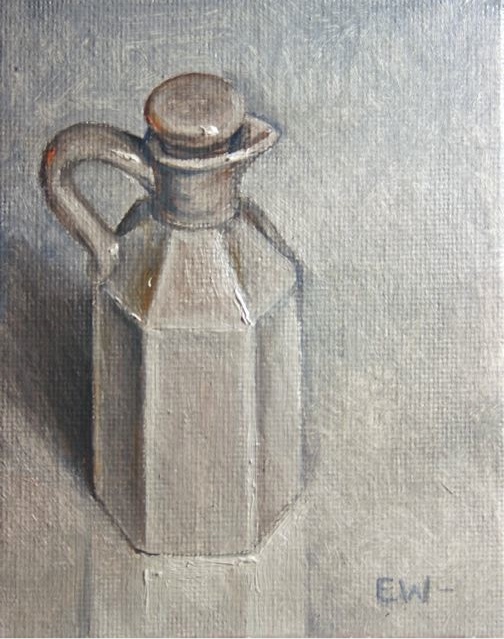
While cooking a pasta primavera one day I was struct by how challenging it might be to paint my little olive oil jar against the equally white counter -- so I did a white-on-white study.

At the intermediate stage I focus on finding and conveying areas of reflected color. (The color of the ground plane -- table, counter top, etc. -- can often be seen reflected in the subject's shadows.) 


During a family outing to Shenandoah National Park I was smitten by my young son's gentle smile -- so I endeavored to capture it. 

Once the underpainting has "set up" and begins to feel slightly tacky to the touch I switch to oil medium to achieve a buttery consistency in the next layer of paint being applied. (My favorite medium is Gamblin's Galkyd, which dries rapidly and produces a flexible, non-yellowing paint film.)


The constant flux and complexity of birds and water haunt me -- so I did a color contrast study of one of our winter neighbors.

Once the underpainting has "set up" and begins to feel slightly tacky to the touch I switch to oil medium to achieve a buttery consistency in the next layer of paint being applied. (My favorite medium is Gamblin's Galkyd, which dries rapidly and produces a flexible, non-yellowing paint film.)


My wife is the most fascinating and intriguing person I've ever met -- so I've drawn her, and sketched her, and painted several one-a-days of her.

Finally, I identify the purest, brightest points of highlight and I lay them in as tiny areas of impasto "icing on the cake" -- and sign my initials. Done!

Note: to view step-by-step still image demos of the last three images in this week's series, please klick on the underlined hyperlinks. Or, alternately, you might enjoy the easy listening soundtrack while watching the video below.

Happy painting!


Monday, September 3, 2012

Art du jour, Part 1

When I was in art school one of my instructors told me, "Art is like a game of golf, the fewer strokes the better." What he was trying to tell me was that art is about clear and succinct visual communication.

Later he told us that, if we really wanted to get better at rendering the world about us, we should free ourselves of our technical "crutches" -- that is, force ourselves to see more carefully and make marks more accurately.

Scalloped Sea Shell, oils on 4"x4" canvas

The first "crutch" to go was our erasers. And, sure enough, after acknowledging the unhappy results of a few (well, probably more than "a few") bad observations and erroneous renderings we did actually begin drawing faster and more accurately.

Hard Candies & Paper Bag, oils on 4"x5" canvas

 The second "crutch" we shed was our pencils -- going straight from our observation to indelible ink. And, again, there was an initial period of disappointment and frustration as we came to grips with the inaccuracy of our efforts. But we quickly learned to slow down; use all our senses; observe specific details, patterns and relationships; and, only when the true nature of our subject had become clear to us, to convey its essence. Art had become rather zen-like, we had become the novice monks -- and we were thrilled at how clear the nature of the world around us had become. Even when we weren't drawing or painting we were looking -- at the way the morning light fell upon an object, at the reflections and refractions to be discovered within a dew drop, at the colors within a shadow.


 Glass Miniature, oils on 4"x4" canvas

 And then came alla prima painting -- painting each canvas or panel in a single sitting, and painting a new work every day. For this exercise a singular subject will suffice, and a small canvas or panel will do. (The object is to develop a clear eye and accurate hand, not necessarily to cover large surface areas in brief periods of time.) 


Glass Jar, oils on 4"x4" canvas

When doing one of these little projects I generally choose a subject that has a hard reflective and/or transparent surface (for me, personally, bright colors are a nice plus). I create a simple environment (a large sheet of middle-toned paper, bent so as to provide both the "base plain" and backdrop will do nicely -- although I also have a fondness for shiny mahogany surfaces too). And a strong light source to one side for nice contrasty highlights and shadows (natural light when I can get it, but often artificial during the winter months) rounds out the "setup".

Sleeping Scholar Chop, oils on 4"x5" canvas

 One of my favorite supports for these exercises are 4"x4" and 4"x5" canvas panels (which I purchase in bulk from Dick Blick) as I can easily hold one in one hand while applying paint with the other.

Glass Marble, oils on 4"x4" canvas

 My personal work process involves a preliminary compositional underdrawing in pencil, followed by wet-in-wet application of oil paints -- generally working from the darks (which, in oils are usually the faster drying pigments) to the lights (which, because of their higher oil retention, are normally slower drying). As a general rule, I only use as much paint medium as is required to obtain a buttery paint consistency. And I tend to prefer using bristle brushes to sable since the former tend to impart (again, for me) a very pleasing impasto brushstroke.

Onion and Jar, w/c on 4"x6" HP paper

 I routinely alternate oils on canvas with watercolor on scraps of precut Hot Press watercolor paper (a medium/support combination that I never leave home without and which I find great fun to work with).

Larry Boy, oils on 4"x5" canvas

I'm constantly on the lookout for new subjects for my little exercises (and am not averse to "raiding" my kids' toy collection). Larry Boy was something they found abandoned on a park playground and rescued from toy oblivion and the ravages of nature. (Our family have been big fans of Phil Vischer and Mike Nawrocki for years.) 

Hopefully, the video below will also give you some insight into my workflow -- although I usually work without a soundtrack. (If you would prefer to see the individual stages as stills, you can click here to visit a special page at my website.)


Post Script, Please keep in mind that this article describes techniques that have proven useful for me. If it also proves useful for you, great! If you choose to modify my example in any way to make it more useful to you, even better still! Remember, you have an Artistic License. Feel free to exercise it in whatever way works best for you. And, if you need any art supplies to exercise that license, be sure to drop by Art Supplies & Provisions Online. (Visitors are always welcome.)

Cheers!


Thursday, July 26, 2012

Old Gold #3 - Venezia

Le Serenissima. Of all the cities I have ever had the pleasure of visiting, arriving by train in Venice has got to rank among the most aesthetically sublime. Approaching Venice over the causeway is visually enticing -- a sneak preview of things to come. The train station is all massive and marble -- perhaps appealing only to those who are fans of Art Deco. But, to exit the station on a sunny day and to be struck by the complementary blues of the Grand Canal and the clear Adriatic sky on the one hand, and the warm earth tone of the Venetian architecture on the other, is to be transfixed.

gondolas (coming and going) near my hotel


And then there are the acoustics. As beautiful as Rome was, the sound level was like that of any modern city anywhere on the planet. After all, street traffic is noisy. In Florence, on the other hand, many of the streets and neighborhoods have been designated pedestrian only, and the only sounds are of voices and the rather soothing rhythmic plink, plink, plinking of masons hammers. But Venice, oh Venice! In Venice there is no vehicle traffic (nor many lanes wide enough to handle vehicles if there were.) The only sounds are those of people and, as you approach the canals, the lapping of water against hulls and the occasional relaxed thump of a slow-turning boat motor.

 a Venetian family "car" 

a peaceful, beautiful backwater 

Granted, there are crowded tourist centers -- historic attractions where visitors frequently outnumber residents. But it is easy to slip away down a narrow calle and spend hours sketching and exploring quiet, but beautiful neighborhoods with their earth-toned houses and small, unassuming churches (frequently housing art treasures that put to shame the collections of many world-class museums.)

 Burano is a delightful riot of pastel colors 


When the heat and the closeness of the alley walls begin to press in on you there are the vaporettos  -- the water busses -- offering a fresh breeze and the open lagoon, making their regular runs to the surrounding islands. Due to the summer heat, I chose to forego a visit to the glass furnaces of Murano and chose, instead, to explore the residential canals of Burano, the Lace Island -- l'isola all'estremità dell'arco della pioggia.

The canals are streaked with every color of the rainbow.


And, in the evening, there were quiet promenades with soothing breezes off the Adriatic, Vivaldi concerts performed by female quartets in period costumes playing period instruments in Vivaldi's own Santa Maria della Visitazione (La Pieta), or simply a late night drink at one of Piazza San Marco's sidewalk cafes (now with most of the tourists tucked safely away in their hotel rooms for the night.)


Interestingly, I usually use the same medium and sketchbook structure throughout a given trip. But not so on my last visit to Italy. In Rome I worked primarily in colored pencil and pen & ink. In Florence most of my work was in watercolor. But in Venice and Burano I alternated between line drawings in pen & ink and oil paintings -- the medium of Titian and Giovani Bellini.

sometimes I sketched on postcards


and sometimes on scraps of watercolor paper tucked into my sketchbook

And, as with so many visitors before me, Venice's siren song continued to haunt my creative thoughts long after I returned home -- even showing up in the form of a glimpse of the Grand Canal (lifted from one of my sketches) in a portrait I did of my daughter in her very first formal gown (for our first father-daughter dance.)

Le Serenissima


I hope you have enjoyed our little visit together and that you'll join me again for the next installment of Old Gold -- when we're off to the Lake District.