Showing posts with label nature journaling. Show all posts

Thursday, November 5, 2020

Coming Soon!

Coming soon - a new series of step-by-step demonstration videos and instructional workshops to supplement the video snapshots I've recently begun posting. 


The step-by-step demos will generally run no more than 3 minutes with minimal text and voice-over. The narrated "full-length" workshops may run up to 1 hour but will likely be posted in 15-minute installments (allowing you to refresh your cup of coffee before starting a new chapter), and may include PDF materials lists.

Techniques and materials will be covered in shorter videos. Longer videos will cover journaling (nature and travel), drawing, and painting, with works covered from beginning to end. And we'll be doing a mix - alternating studio works with on-location plain air. (Watch for visits to some exciting destinations just as soon as we can put the pandemic in our rearview mirror.)

So, bare with me as I get the video studio back up to speed (and work out a few bugs - like remembering to turn off the metronome "click" in the audio track.) Watch for regular "test videos" to be announced here and - depending on their length and format - posted to my Facebook, YouTube, or Instagram/IGTV channels. And join me for the new art adventures.

Oh! If there are particular topics, techniques, or subjects you'd like to see covered - please let me know by leaving a suggestion in the Comments.

Thanks!

Monday, November 17, 2014

Zion!

Anyone up for a little High Adventure?

Sunrise, South Zion NP 5-14a
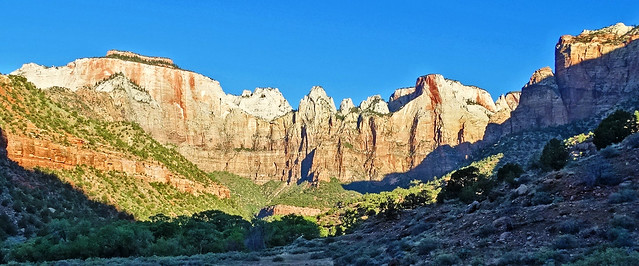
sunrise in Zion National Park (to say that the light in Zion is "dynamic" would be an understatement)

The National Parks Service folks at Zion National Park have made their selection for the 2015 season and I've been invited to participate! (http://www.nps.gov/zion/parknews/2015airannounced.htm) In fact, not only am I going to spend a month drawing, painting, and video taping in this awesome natural wonderland... I'm going to be doing it during what is arguably the park's most colorful season -- autumn! (http://www.zioncanyon.com/blog/autumn-zion-national-park/)

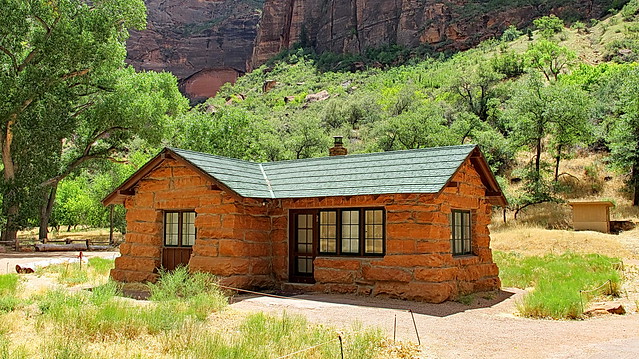
Zion National Park - Grotto Building - First Visitor Center
during my stay I'll be living in the Museum-Grotto House (built circa 1927) -- 
just sets away from the Virgin River, hiking trails, and awesome canyon views

Early Fall, Zion National Park
my residency period will begin with the onset of fall color and run through the full (spectacular) range of color change

The current plan is to spend one week driving to Zion (with a couple of "painting breaks" en route -- at Canyon de Chelly and Monument Valley) and four weeks in the park itself. Watch for the launch of my new Kickstarters! crowd funding venture soon. (I'm planning some really interesting "thank you" gifts for my supporters this year -- including artwork, DVDs, and much, much more.)

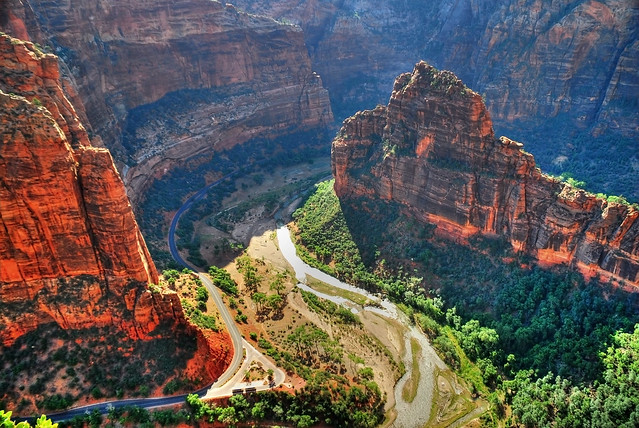
Zion Canyon view from Angel's Landing - Zion National Park, Utah
you can expect some really spectacular views from the canyon floor (and maybe a few from the rim)

Zions
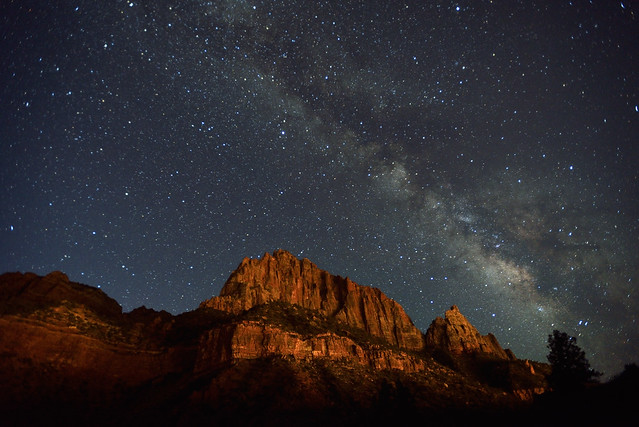
I even plan to try painting by headlamp (mine, not the car's)

I'll be posting regular (well, as regular as internet availability permits) updates here on the blog -- during the lead-up prep, en route, while in the park, and during my return). And I hope you'll join me here when we launch this exciting voyage of discovery. In fact, if you find yourself in the southern Utah area during my residency, I hope you'll consider joining me for the FREE public workshop I'll be offering (date TBA); I can pretty much guarantee a good time (and door prizes) for all!

Once a Home, Grafton Ghost Town, 4-30-14s
my residency at Zion will even allow a sketching & painting excursion to the ghost town of Grafton 
(setting for the "bicycle scene" from the 1969 film Butch Cassidy and the Sundance Kid)

Stay tune for updates and additional details soon.

Cheers!  

Image credits: All images in this article are used with permission under Creative Commons licensing agreement (https://creativecommons.org/licenses/by-nc/2.0/). Copyright belongs solely to the original artists. My thanks to (from top to bottom) Don Graham, Alan English, Carl Berger, Jono Hey, Eric Ward (no relation), and Don Graham again. 

Monday, September 15, 2014

"Houston, We Are Cleared for Launch!"

"Houston, we are cleared for launch. T minus 30 and counting."

To maximize the multi-media experience for readers unfamiliar with the Multi-Touch 
format a 3-page user's guide to the book's "bells and whistles" has been included

Well, OK, I don't live in Houston and publishing a media-rich, interactive ebook isn't exactly rocket science. (Although, for someone who usually makes his living with technologies that harken back to the Rennaisance and beyond, it can sometimes "feel" rather Buck Rogers.)

Hi-res panoramas, oils sketches, and (on the following page) finished paintings abound

Everything has been checked -- images are all in place, the text has been proofread (thrice) for typos, all the videos run, and all scrolling sidebars scroll. Apple has approved the final manuscript (all 155 pages). Sales begin in 51 markets* world-wide on October 15. (That's where the "T minus 30" came from.) And pre-orders begin TODAY!!!

Pages from my journals are reproduced throughout the book

If you like the images in this post (All are screenshots from the book.) please visit the iBookstore (https://itunes.apple.com/us/book/the-north-cascades/id916569774?mt=11&uo=4&at=1l3voTi) to see more. Be sure and download the FREE sample excerpt. And, if you find it interesting, I hope you'll buy the book... and tell your friends. (Please note that 100% of my royalties go to support future adventures and the books they generate.

Text from my adventure blog is combined with excerpts from my field 
notebooks and all-new notes and observations

Thanks, as always, for your support. 

* NOTE: To make navigating to the Apple iBookstore easier for readers living outside the U.S. I'll be posting hyperlinks (2 each day) to stores in each of the 51 countries currently served in the Comments section below. (If you don't see yours please check back or PM me.) Cheers!

Wednesday, August 20, 2014

North Cascades - The Penultimate Progress Report

adding a 1951 Chevy DeLuxe to the "cultural artifacts" journal 

I've selected the final 83 works on paper, 20 oil paintings, 156 photos, and 13 videos for the new book. I have one more panel painting (OK, maybe two) to prepare while I do the final proof reading. And then North Cascades can be sent off to the publisher. (Yea!)

completing a study of balsamroot (this time sans bears)

I thank you all for your patience and support while I've been working away at this project over the past few weeks.

And, if all goes well, my next post will be to announce the release date for North Cascades: A Tale of Two Seasons (Spring). Cheers!

Thursday, September 5, 2013

A Sense of Place (The Exhibit): Part 1

"What is this life if, full of care, 
We have no time to stand and stare."
                               -- W. H. Davies

Beginning on the 17th this month and running till October 31st, I've been invited to exhibit some of my nature and travel journals at the Central Library in Fort Worth, Texas, and to teach a series of four journaling workshops (three beginning and one advanced) for the general public.

just a few of the journals and journaling-related items that will be on public display


  • The first workshop (entitles Sketching from Nature) will be held at the Fort Worth Botanical Garden from 10 a.m. to 3 p.m. (with a one-hour break for lunch) on Friday, September 20. 
  • The second workshop is entitled Sketching on Location: Place-based Journaling and will run from 1-5 p.m. on Saturday, October 5, at the Log Cabin Village historical park. 
  • A 3-hour workshop on Urban Sketching will be held at the Central Library from 1-3 p.m. on Sunday, October 13 (following which interested participants can opt to join me for some sketching in nearby Sundance Square). 
  • And a workshop entitled Advanced Sketching: Toned Paper will meet from 9-11 a.m. on Tuesday, October 29.

All workshops are free and all required materials and supplies will be provided. (Take them home with you afterward to continue your journaling adventure!) Enrollment in each workshop is limited to 10 participants each (to maximize one-on-one instruction time), so early enrollment is highly recommended. Participation by all ages and experience levels is most welcome, but please note that under-aged children must be accompanied by a parent or guardian.

Over the next several weeks I'll be posting a series of articles, each focusing on a specific travel adventure, journal type, or sketching technique, that you can expect to experience in person at the exhibition and during the workshops.

For additional information you can drop me an email, visit the library's activities site online (http://fortworthtexas.gov/library/WorthReading/event/?id=114616), or phone 817.392.7323 to register.
If you happen to live in the greater DFW area (or will be visiting the area), please consider joining us.

"The real voyage of discovery consists
not in seeking new landscapes but in
having new eyes."
                                   -- Marcel Proust

Thursday, March 21, 2013

A Rim With A View, Part II (Let's Get It Started)

over the next few weeks I'll be looking at this image a lot -- every time things get too hectic and 
I ask myself "Is it worth all the madness and frenzy?" (Of course, the answer is "You bet!")

Before I get to Crater Lake, before I settle into my little cabin on the rim, and before I start exploring the quietude of a magical winter wonderland I've got to deal with the logistics; I've got to actually make this adventure happen, and (given that I have six weeks or so to pull it all together) things will certainly get a little crazy around here!

So, when I get to Crater Lake I'll take a deep breath (a very deep breath!), relax, and start listening to Cat Stevens' "The Wind". But, starting today, I kick it into high gear, put on the Black Eyed Peas, and crank up the volume -- "Let's Get It Started In Here!"

The Kit, Evaluation & Update

never leave home without it


Already having several travel adventures under my belt, my "daily carry" and "long haul" art kits are pretty much set. But, before each new journey, I like to reevaluate my kits; see what new developments and new products may have come on the market since my last outing, and confirm that I've selected the best gear for the project at hand.


My daily carry sketch kit (the one I never go out the door without) is a small canvas tote containing my journal, my red Sakura Micron pen tote (black ink in assorted nib sizes), a tin of graphite pencils, a tin of Prismacolor pencils, a tin of Sakura Micron color pens, a fully loaded 2-pen "fountain pen kimono" (watch for more about this in a guest post on Cathy Johnson's blog just as soon as we get the sewing machine de-bugged), my spare pair of eyeglasses, and my clip-on 2-lens magnifiers.

During my residency with North Cascades National Park two years ago I found that my 3.5"x5.5" Moleskine pocket notebook was not up to the demands I put on it and I will definitely be carrying a different pocket-sized journal. (Watch for a hands-on evaluation of the "finalists" soon.) I also carried Moleskine 5"x8.5" Japanese Albums & Watercolor Journals. Both served quite well, but I'm still looking at a few remarkable options that have been introduced since then.

my "long haul" art kit

My long haul art kit (the mobile studio that supplements my daily carry anytime I will be away from home for more than a day) fits into a small backpack that I've carried since our two-month sketch crawl of Europe in 2009. It contains an Arches 10"x14" HP watercolor block, a 24-color Daniel Smith watercolor box and a 12-color DS "Bijou" watercolor box (both of which I've carried for over 20 years), assorted watercolor brushes, a pocket-sized pair of binoculars, a Cannon digital camera (which doubles as an HD video camera), my Apple iBook Pro, power and connection cables (for the Cannon and Apple), a first aid kit (including any prescription meds), survival kit (bivouac bag, emergency food, and fire starter), water bottle (which will remain empty during the flight up and back), and one change of clothing.

Field Work

sketching this week at the Log Cabin Village in Fort Worth

OK, this is without a doubt the most enjoyable part of getting ready for any new adventure. It's where I establish the daily routine I want to maintain while I'm off in the woods, make certain that I really have everything I'll need to sketch on location (and shed anything that I only "thought" I'd need).

The goal is to be at a point where I routinely go out drawing every day (easy), all day (a bit more challenging) by the time I depart for Oregon. Already I'm going for long, slow walks, stopping frequently, and strengthening my perceptual "muscles" (not only by sketching, but also by soaking in all that I can experience of the moment -- the long song of a mockingbird singing its heart out, the sound of a gust of wind as it swooshes through the new foliage of a tree freshly awake from its winter sleep, and the sighting of a tiny bird newly returned from its winter residence. And, equally important, I am looking for the "artifacts" of earlier generations of human inhabitants -- buildings, old fence lines, and any other signs that another set of feet passed my way before. I am also on the lookout for small artifacts or bits of nature that fit easily in the hand or pocket and that can be carried home to draw later -- thus increasing the number and range of my subjects. (Of course, National Parks have strict rules on what may or may not be gathered and I adhere to these rules meticulously -- both for the health and wellbeing of the park, and for the experience of future visitors.)


Stay tuned to see how I do.

Getting In Shape

taking a group of sketching enthusiasts out for a bit of nature journaling at CLNP may be "challenging" 

If you're a "flatlander" like me and have been a bit too sedentary over the winter months, getting into shape is an important consideration for the outdoor artist before venturing to a destination that sits at 7000-8000 ft. (2100-2400 m.), doubly so when trekking from one scenic spot to another may likely involve hours of cross-country hiking on snowshoes, and even the remote possibility of getting stuck outdoors over night could involve temperatures in the range of 19º F (-7º C).

So, I've begun a daily regimen consisting of 1 hour on a cross-country ski machine (which will be increased in duration each week till departure) augmented with daily hikes with my border collie (She'll make sure we maintain a brisk pace.) bike rides and sketching safaris (all venturing farther and farther afield over time).

The Gear

As with my studio kit, I don't have to begin from scratch here; much of the gear I used in Stehekin is perfectly serviceable for this adventure too. However, I will be experiencing more snow, more frequently, and in greater depths than at North Cascades National Park. So, a few extra items will likely be called for. (Fortunately, my hosts at Crater Lake have already indicated that they'll be able to provide snowshoes and some other outdoor essentials, which will be very helpful.)

The first order of business is inventorying my outdoor equipment and determining what might need repair or replacement. For example, my hiking boots are in very good condition but have developed a pronounced creaking noise when I walk in them; I'll have them checked out by a cobbler and apply a new waterproofing treatment before I go. I have two pair of cargo pants that should suffice. But I'll check all the stitching and deal with any needed repairs before packing. Already I know I will need some additional liner socks** and outer socks for the trip, and winter underwear.

Sadly, my trusty folding stool won't be making this trip as it would immediately sink into the snow. For this trip I'm thinking a roll-up square of neoprene would be far more serviceable: both waterproof and well insulated against the cold.

** A note about outdoor clothing: I'm a big fan of light cotton in warm weather. In fact, I live in t-shirts and shorts for much of the summer. However, cotton has no place in my winter outdoor wear. It looses all heat retention when wet and, once wet, is very slow to dry. So, my cotton socks, underwear and outerwear won't be making this trip. (Staying warm and dry will help keep you safe and comfortable, and that in turn will make it easier to focus on enjoying the experience and making art.)

Watch for more details about my gear selection in upcoming posts.

The Budget

Of course it shouldn't come as news to anyone that adventures cost money. And underwriting a venture of this magnitude can call for almost as much creativity as the artwork I'll produce while in the wilds of Oregon's Cascade Range.

It looks like air travel will be on the same carriers as our NCNP adventure!

Option 1: "Say! What's that?" -- The first addition to my new set of fundraising tools is the new PayPal "Donate" button in the sidebar -- safe, secure, and simple. It allows individuals to donate an amount of their choosing either via their PayPal account or credit card.

Option 2: Kickstarter -- Kickstarter is a relatively new, secure online "social fundraising" option for creative projects. An individual or group comes up with an awesome project that needs funding, they complete an online application by put together a project description, a budget, a schedule (both for fundraising and for completion of the project), a verified Amazon account (more about the money in a moment), a list of contribution levels and the perks or rewards that donors will receive at each level (kinda sounds like PBS Pledge Week doesn't it?), and (this is optional but highly recommended by the folks at KS) a short promotional video. Once the application has been completed it is submitted digitally to KS for verification that the project adheres to the KS guidelines. If it does (and if the project author(s) have done their homework it should) the project will be visible in Kickstarter online catalog of fundraising ventures. All that's left is to start getting the word out and hope the pledges start rolling in!

Now, I promised an extra word or two about the Amazon account earlier and here it is; Kickstarter is all-or-nothing! That is, if (and only if) the project receives enough pledges to meet the budget set by its creator Amazon will collect the funds and distribute them to the project. If the financial target isn't met, however, nothing is collected and this fundraiser is a bust. The reasoning behind this is that if the proposal is honest the target amount is truly what is needed to make the project feasible. Anything less and the likelihood of a successful outcome becomes unrealistic.

So, how about visiting my Kickstarter Project Page today, watch the short video, check out the amazing range of rewards I'm offering for your support, and consider making a pledge? (Some of the items offered are limited in number so be sure and reserve yours while supplies last. And note that international donors are welcomed and international shipping of rewards is available.)

Option 3: Shopping Amazon -- If you can't spare an outright donation but still want to support my Crater Lake project, consider doing your online shopping through my Amazon Affiliate page. You pay no more than you normally do at Amazon and your transaction is completely secure. (In fact the entire checkout process is handled by Amazon.) But I receive an Affiliate commission that will be applied toward the trip, and (without spending a penny more) you have the satisfaction of knowing you've supported a worthy cause. (Thanks!)

Option 4: Shopping Etsy -- Why not take a look at the selection of vintage and handmade goods I offer at my Etsy shop. Again, any revenues will be applied toward making this breathtaking adventure a reality.

Option 5: Please tell a friend -- The more people who know about the "Rim With A View Project" the greater the likelihood that I'll be able to bring it to fruition. And, too, folks who find out about the venture are more likely to subscribe to the blog and share in the (free) online postings.

May at Crater Lake will be a little bit different than May in North Texas

__________________________________________________________


OK, in Part III I'll be posting artwork from the "Field Work" portion of the preparation stage, and both my final Kit and gear selections. Part IV will be posted "on the road" -- en route to Crater Lake, from the rim of the crater (or at least from my cabin near the rim), and the trip home. In the meantime watch for other interesting articles covering everything from urban sketching and "lost" history to this year's crop of spring wildflowers (and, believe it or not, dinosaurs even play a part in one upcoming article).

Happy trails!

Friday, March 1, 2013

A Rim With A View, Part I

Some 7,700 years ago two very spectacular geological events occurred in south-central Oregon that are now set to have a profound effect on my journaling. During the first event Mount Mazama blew its top. During the second "event" Mother Nature filled the volcanic cone with water, creating the deepest lake in the United States with some of the cleanest, clearest water in North America. (The record for visibility in the lake stands at 144 vertical feet!)

how's this for a rim with a view?

Fast forward 7+ millennia to 28 February, when I received a telephone call from the Education Coordinator at what is now Crater Lake National Park and an invitation to be the Park's 2013 winter Artist-in-Residence. Now, for those of you who are a flatlanders (like me) let me interject that "winter" in this case does not mean next November or December. No, in the higher elevations Oregon'c Cascade Mountains, winter means May. (And lest you think that's a joke I will share with you that I've been told that I can expect to find snow depths of as much as 8 to 12 feet when I arrive!) So, I've got just over two months to pull my kit together, get myself in shape, make my travel arrangements, and reestablish a rigorous day-long sketching routine. And I thought you might like to come along through a series of articles -- both as I prepare, and on the adventure itself.

So, in the next post in this series I'll share with you the kit I'm putting together for this expedition and some of the exercises (physical and artistic) I'm doing to get "in shape" our trek into the High Country. Please stay tuned -- and welcome aboard!

______________________________________________________


OK, I should probably apology to E. M. Foster for taking the title of his delightful novel in vain -- but, as you might imagine, I'm in a particularly "exuberant" mood, and my sense of humor tends to get a bit quirky when that happens.

Monday, October 8, 2012

Tricks of the Trade #2 - Fireflies, Dry Flies, & Bug Boxes

cicada (Tibicen linnei)

Some eight years ago my friend and fellow nature enthusiast, Mark Baldwin (who also happens to be Director of Education for the Roger Tory Peterson Institute) introduced me to a little tool that opened up all sorts of new insights and discoveries into the realm of insects and flowers -- the hand-held magnifying lens.

katydid

The first lens he introduced me was a folding jeweler's loupe with clear plastic lens and opaque case that doubled as a handle when opened. This was a very useful tool at the time and, thanks to the innovative addition of more powerful lenses and a LED light source, is even more useful today.

the basic 10x magnifier costs $4.95

this folding jeweler's loupe offers 20x & 40x magnification and an LED light source for just $6.21 


The second hand-held magnifier Mark introduced me to was a more economical, non-folding two-lens model. By adding a simple lanyard cord it can be worn about the neck -- freeing up your hands when you don't need it and avoiding the possibility of accidentally misplacing it.

the non-floding two lens magnifier costs just $1.50


The third magnifying device I became familiar with is ideal for field sketching the really small details of insects, flora, or mineral samples -- an illuminated, hand-held microscope not much larger than a US 25 cent coin but sporting a remarkable 45x magnification!

the amazing 45x hand-held microscope cost just $3.77


For the nature journalist these tools all make magnificent (better still, essential) additions to any field kit. With them you can see the detailed workings of joints, antennae, eyes, mouth parts, petals, stamen, gills, fins, feathers, et al. Without them we are left to guess at the true nature of the the flora and fauna around us.

Unfortunately, there is one dilemma to the hand-held magnifier that nagged me for the better part of eight years. If I held a specimen in one hand and magnifier in the other I was one hand short for sketching my observations! The solution (observe the bugs or plant, fish or fowl while storing as many details in my short-term memory as possible, put down the magnifier, pick up my pencil and draw what I remembered, put down my pencil, pick up the magnifier, begin the process again) was labor-intensive,  time consuming, and sometime quite frustrating. So, the search was on for a hands-free magnification system.

***

The first hands-free solution I found worked wonderfully for insects and other small objects: a small acrylic "bug box" with a magnifying lens integrated into the lid. I could study a subject at length, even take it back to the studio if necessary, and both hands were free to deal with sketchbook, pencils, pens, and brushes.

magnifier bug boxes are available in two sizes at $2 for small & $3 for large


But the bug boxes could offer when sketching something too large to fit inside was the use of the lid as a hand-held magnifier. The search was still on for a magnification system that could be used sans hands and could deal with larger specimens -- and I found it while fly fishing (my other labor-intensive, time consuming, and sometime quite frustrating pastime).

a pair of size 22 flies (dry, top & nymph, bottom) - dwarfed by a penny!

If you happen to be a fly fisherman, and have ever found yourself trying to tie a size 22 dry fly to a 7X tippet in low light (especially if your eyes aren't quite as young as the use to be), you know the real challenge of seeing fine details. Fortunately, Cabela's sporting goods stores have the solution for optically challenged anglers and (by extension) two-handed nature journalers too: the Firefly Magnifier.  Just clip the Firefly onto the brim of your baseball cap, flip the lens up, and forget it! When you have a sketching subject in hand, place your journal in your lap and flip the lens down. Then it's an easy procedure to go from taking in details to simply lowering your eyes to your sketchbook, and back again. There are even two models to choose from: one with magnifier alone, and one with a tiny but quite powerful LED light source (powerful enough to help you find your way back to your car if you stay too long on the river at dusk). And an added plus, the Firefly has two parallel lenses, thus offering journalers binocular vision for greater depth perception and less eye fatigue.

the Cabela Firefly (LED model) in action

At $24.99 for the no-light Firefly clip-on and $39.99 for the LED Firefly (battery included), I was concerned that this might be a bit pricey for most budgets. Fortunately, over time the price for clip-on magnifiers has come down as the magnification options have gone up.


this pair of magnifiers clip onto a baseball cap & cost $6

this 2x pair clips onto prescription or sun glasses & will cost $10.95

And, finally, any time you head out for a little field don't forget to pack your field guide. It fits perfectly into most kits and is a wealth of information (and neat illustrations).


this Peterson guide is my favorite, both for its overall coverage & more artistic illustrations

Looking for one of these items but can't find it at your local art supply shop? You can always find it at Art Supplies & Provisions Online!

***

How the Trick Works: To use the hand-held magnifier, hold it approximately 3-4 inches from your dominant eye with your drawing hand. Hold your specimen in your free hand and gradually move the specimen toward the lens till it is in focus. Use the smaller/higher magnification lens for observing the finest details on stationary subjects. And use the larger/lower magnification lens for insects and other moving subjects.

cicada killer wasp (Sphecius speciosus)

Sneak Peek: I currently have several product tests and evaluations well underway and will publishing reviews in coming weeks -- and, thanks to the generous support of some of our manufacturers and distributers, I have some nifty product giveaways planned for the very near future. (Hint: it involves pens and accessories.) So, please stay tuned -- or better still, choose one of the 3 subscription methods in the sidebar and the latest articles will come to you.

Cheers!


Monday, September 10, 2012

A Sense of Place


"Eventually, all things merge into one, and a river runs through it."

                                                                                                             -- Norman Maclean
_________________________

If we're lucky, some of us have an opportunity to travel to faraway places where -- because of the exotic geography, unfamiliar language and customs, alien weather, and culinary surprises -- we experience an acute, unique awareness of Place. In such unfamiliar surroundings it becomes quite easy to become aware of the details and specific nature of Place. But, with a little effort, it isn't necessary to travel far afield to become intimately away of Here and Now. Everyplace has its history, its geography, its climate, and its culture. And, with a little practice, we can all discover wonderful stories -- right in our own backyards -- worth recording, and worth sharing with others.


Some time back I was looking for a theme for a sketchbook project I planned to enter in a popular national exhibition, and I was looking for a way to introduce my youngsters to the marvels of the natural world. I found the solution to both in my own back yard; a stretch of river (more stream really) all but hidden by the old hardwood trees that lined its banks, the Clear Fork of the Trinity River.


Our little stretch of the river is one of the few sections that wasn't "channelized" by the Corps of Engineers and the water authority during the 60s and 70s. And one of the first things we learned about our little ecosystem was that where you find vegetation and water you find insects -- cicadas, spiders (in all shapes and sizes), walking sticks, damsel flies, and dragon flies.


And where there are water, flora, and insects we found birds -- aquatic plant-eating ducks, seed eaters, and raptors.


In the spring we were treated to wildflowers that carpeted the flood plane that connected the river to the ponds of our wildlife refuge -- Indian Paintbrushes, Evening Primroses, Bluebonnets, and a dozen other species that arrived one after the other. We drew them, mapped their location, and sometimes pressed them in our journals. 


During our explorations we would occasionally discover old, rusted artifacts -- a fallen barbed wire fence, a line of weathered fence posts hidden in a patch of trees, and old, long-forgotten padlocks. So we researched the ares history and learned that what is now suburban neighborhoods was, not to long ago, a huge working ranch that stretched along the Trinity River from what is now downtown Fort Worth to the town of Benbrook. 


We also discovered that where there is a diversity and abundance of plants and insects, and clear-running water, there a variety and abundance of fish -- and that if you "catch and release" it will stay that way.


We looked at the trees, tried to identify them, and researched their history. We learned that some were a prolific source of high-nutrician, free food, others provided excellent, renewable building materials, and still others had long-ago developed formidable defense systems to protect themselves against ravenous herbivores that went extinct long, long ago. 


Most of "our" Clear Fork is shallow enough that we can explore its length and breadth in calf-high rubber boots -- discovering giant tadpoles (that tickle your hands), crayfish, fresh water clams, and several species of turtles.

We found a weir (which the kids called their "waterfall") that was built in 1914 and a limestone outcrop that once been part of an ancient seabed, replete with a diverse cache of 50 million year old fossils.


And we spent long hours (that seemed anything but) marveling over insect hatches and the "creepy-crawlies" that live under rocks of the stream bed.

So, the next time you're preparing for a globe-trotting adventure and you want to fine-tune your skills before you go, think about trying what we did. Begin in your own back yard!

____________________________

"The river was cut by the world's great flood and runs over rocks from the basement of time. On some of the rocks are timeless raindrops. Under the rocks are the words, and some of the words are theirs.
I am haunted by waters."
                                                                                                                __ Norman Maclean

____________________________


NOTE: For brevity's sake I've only included nine of the double pages from the original Clear Fork journal. If you'd like to see all 38 pages of the complete journal, cover-to-cover, I invite you to click here. 

PRODUCT MINI REVIEW & A TRICK OF THE TRADE: The sponsors of the aforementioned sketchbook exhibition required all participants to use the sketchbook they provided for the project -- a plain 5.2" x 8.4" Moleskine Cahier. The Cahier sketchbook is produced in a handy pocket size and sold in an economical three-volume set. The paper is well suited for dry medium (graphite, carbon, and color) and will handle some fast-drying inks (ballpoint, roller ball, and gel). But it is not intended for particularly wet medium (a limitation that the exhibition sponsors should have taken into consideration.  While using pen & ink, marker, or watercolor will almost certainly result in bleed-through and some paper buckling, there are creative solutions for those who wish to work with this handy little notebook. In my case the solution was to draw/write on two facing pages, skip the next two facing pages (because of bleed-through), write/draw on the next two, and so on. After the sketchbook had been filled and all of the pages were completely dry I pressed the book to reduce page buckling and then -- using Tombo Mono archival two-sided permanent adhesive tape -- pasted the facing pages that had not been drawn on together. This eliminated the bleed-through problem and effectively doubled the ply, or weight, of each page. 


Thursday, August 2, 2012

Art Education and the No Child Left Inside Act


Once a week I drive my children to afternoon lessons -- Japanese for my daughter, violin for my son. For several months our route took us past a construction site and each week we watched as first the site was cleared and leveled, then the foundation was laid, and finally the walls were constructed. As the walls neared completion a row of narrow horizontal windows were added. Observing that, while these windows might allow sunlight in they certainly wouldn't permit a view out, one of my children asked, "Is this new building going to be a prison?" To which I smiled sadly and replied, "No Sweetheart, that's an elementary school."

In 2005 Richard Louv wrote Last Child in the Woods: Saving Our Children From Nature-Deficit Disorder. In the book Mr. Louv noted that as our society was becoming more digital two disturbing things were happening to our children: they were becoming less connected to nature in their daily lives, and they were becoming alarmingly out of shape.


Heeding the alarm, members of both houses of Congress introduced the No Child Left Inside Act in 2008 to encourage schools to integrate environmental education into the curriculum and, for at least part of the school day, to get our kids out of the classroom and into nature. (The bill didn't pass but the seed had been planted within the educational community.)


That same year I helped organize a team of interested educators at the school where I was teaching: science, English, history, math, and visual arts teachers who were interested in investigating the potential of nature journaling. We were intrigued by the idea of taking our students out into nature (just the mention of "going to the river" was enough to solicit whoops and hollers -- student motivation? check!) and then use their common journal as a tool for scientific observation and enquiry, research into the natural and cultural history of the region, sketching from nature, and creative writing (even poetry!)

Fort Worth Botanical Gardens

In 2009 I began traveling the country and teaching my own nature-based sketching and journaling workshops at nature centers, school districts, and state and national parks -- for children and their parents, and professional development workshops for enlightened faculty who recognized the value of nature as an untapped educational resource.

Flint Hill School, Oakton, VA

Rick Evans Grandview Prairie Conservation Education Center, Columbus, AR

North Cascades National Park, Stehekin, WA

Congress has yet to pass the No Child Left Inside Act, but that may be a moot point. Across America, states and communities are taking the initiative and creating their own NCLI coalitions... and kids are once again enjoying experiential learning in the great outdoors!


Post Script: This week's post was written from my own experience as an art educator in the United States. I would love to hear how art educators in other countries are using journals in (and out of) their classrooms too. Cheers!