Saturday, October 24, 2015

Sunshine, Thunderstorms, and Flash Floods -- Oh My! (Week 1 in Zion)

My apologizes for the tardiness in getting my first Zion post online but, as I’m sure you can imagine, I’ve been very slow to take time away from exploring and art making to sit in front of a computer screen (and can only do it for brief periods before once again surrounding myself to the call of the wild.)

yea, I was disappointed too when they didn't give me a ranger hat 

My drive to "work" took three days and covered parts of four states... and was marvelous! 

the long drive

Day 1 was the longest, and most stressful (last minute double checking to avoid arriving at our destination only to discover something vital was left on the dining room table) although the stress usually gives way to euphoria within an hour of leaving home. The drive from Fort Worth to Albuquerque over rolling woodlands, through table-flat cotton country, and into Texas high desert scrub country. In New Mexico we passed through Billy the Kid country before we joining I-40 for the nighttime run into Albuquerque (with some very decorative lighting effects along the roadway and on overpasses.)


Day 2 had us awaking to the high desert scenery of the city... and discovering an unexpected classic car collection right across the street from our hotel.

I can imagine either one of these as a studio-on-wheels (altho' the Stutz won't carry as much)

Albuquerque to Flagstaff had us skirting the edge of the Four Corners area Indian Nations with their beautiful desert landscapes and sparsely populated vastness.


Arrival in Flagstaff was another after dark event, though much earlier than that into Albuquerque had been.

the last leg (up hill all the way)

Day 3 had us awakening in a mountain forest, descending through scrubland hills, and entering first the flat and then canyon country of the northern Arizona Navajo peoples.

my son's first cross-country drive (no extra charge for the mountain roads)

After passing through Page (and skirting briefly the edge of what I think is the most picturesque lake in America — Lake Powell) we began a series of climbs. The most notable began just after the Highway 89A turn off and was marked by a breathtaking turnout, where we stopped for the amazing views… and the kids ended up purchasing handcrafted jewelry from the four venders who maintained stalls within sight of their homes on the plain below.

shopping for jewelry on a mountainside was a delightfully serendipitous event

After the turnoff onto Route 9 at Mt. Carmel Junction we drove through rolling farm and ranch land before entering Zion NP through the east gate. Then came the amusement par ride: a mile-long tunnel that was so dark (no interior lighting) that I thought my headlights may have been burned out, followed by the most picturesque series of switchbacks I’ve ever driven in the US. Delightful!

beginning the switchback descent into the canyon

Met Gustava Hotskins, the park’s acting AiR Coordinator at the Human History Museum, received my White Pass (for driving a private car above Canyon Junction), got checked into the Grotto House, and dropped off all my gear.

At this point (thanks to the discovery of two folding cots in the house) the original plan for Misha and the kids to make the drive back to Flagstaff for the night was scrapped and we drove into Springdale for a very enjoyable patio dinner, followed by a visit to the Sol Market to stock up on provisions for my stay.

And, because the return to Flagstaff was cancelled and we found ourselves returning to the Grotto House after dark, we were able to come to the aid of a couple who were out on the no-lights Canyon Road after dark with no lights of their own… and having missed the last shuttle back into Springdale. After dropping off my groceries, wife and daughter, my son and I gave the couple a lift back to their hotel And, en route, learned that they had lost track of time during their climb to Angels Landing… when he stopped to propose to her. Thankfully, by the time we dropped them off the stress of trying to make their way in the dark had given way to relief and laughter and, hopefully, a memorable story to tell their grandchildren. (She said, “Yes.”)

our last photo together till my crew returns for me

Day 4 began with me seeing the family off to California and then I was out and about exploring — mouth agape at the shear beauty and vertical scale of my new surroundings. It seemed that, no matter which way I turned, there was a breathtaking scape to be captured on paper or panel!

the Pa'rus Trail between the Visitors Center and Canyon Junction

Day 5 — up well before dawn and work began in earnest. (What, you didn’t think I was going to work that in somewhere?) The canyons are a non-stop series of vistas. But, as a general rule, those on the west wall are going to be best lit in the morning while those on the east wall will be most dramatic in the afternoon. And some views — like the Watchman and the range south of Canyon Junction — are best during the “golden hour” just before sunset. So, I am out: identifying subjects I most want to sketch and paint, determining their compass bearing from my chosen vantage point, identifying nearby geological formations that may cast unwanted (or desirable) shadows, and determining the best time of day to capture the scene on paper or panel.

Day 6 — more scouting and mapping this morning — first on the river near the house and then up canyon. 

To minimize pollution, and curtail traffic congestion, in the canyon Zion NP and the town of Springdale have implemented two free shuttle systems — one running from the park entrance to the top end of the canyon, and one running from the bottom end of town to the park entrance. Add to that the bicycle the Park Service has provided my during my stay and I’m free to explore and discover every subject and vantage point on the canyon floor.

Popped down to the Lodge to introduce myself and to log onto their wifi (The folks at the Zion Lodge have kindly offered me VIP access to their wifi network for the duration of my stay so that I might get these weekly posts out to you.) and then hiked the half mile Grotto Trail back to the house to the sound of thunder rumbling in the distance. (It echoes majestically off the canyon walls and seems to go on forever.)

As I reached the house the sunny sky went dark and, within 10 minutes, the bottom fell out as a torrent of rain cascaded into the canyon… punctuated at the end by a hailstorm that peppered my windows and left the Grotto area carpeted in white. The surrounding canyon walls also sprang a dozen or so (in this area alone) new waterfalls with torrents cascading the 2000 feet or so to the canyon floor. It was all so exhilarating! (Of course, when a second storm struck in the middle of the night and I could hear the roar of the river — but couldn’t see the river’s edge — “exhilarating” was no longer the descriptive that came to mind.)

hard water?

Day 7 — the first week has flown by! I’ve discovered and experienced so very much already, with so much more yet to come. The summer warmth, with temperatures in the mid 80s, that greeted us has given way to fall temperatures that begin the day in the 50s. The sky alternates between brief glimpses of sunshine and overcast. But the morning is dry and OK for exploring (as long as I take my rain gear long, just in case.) And the afternoon showers are moderate. 

Up and down the canyon maintenance crews are out in force clearing the roads, trails (and lodge parking lot) of the red, clay-like residue of yesterday’s runoff. And I’m busy on yet another study, and enjoying a nice culpa tea.


Oh, PS, if any of you are going to be in Zion NP on Friday, Oct. 30, please join us at the Grotto picnic area at 3pm for a free Sketchbooking and Place-Based Journaling Workshop (Strathmore sketchbooks and Sakura pens included.) Hope to see you there!
__________________________________________________________


NOTE: Future posts from Zion are likely to be briefer as I intend to spend more time afield. But I think you’ll find the content, and especially the images, interesting. Cheers!

Monday, October 5, 2015

Sunflowers, Rain Lilies and False Thistles (The Final Zion Prep Update)

8 days and counting! (In fact, between packing and traveling, things could get so busy that this may be the last prep post. 

thumbnail comp, graphite on Bloc Rhodia No. 13

Took some time out from all of the Zion prep for a week-long celebration of my daughter's sixteenth birthday. (Oh, they grow up so-o-o fast!) And then, to commemorate the momentous occasion, I knocked out an oil sketch of her tinted sunflowers as a little keepsake for her.

Kate's Sunflowers, 8"x6", Gamblin oils on Ampersand Gessobord

The weather is finally beginning to hint at autumn (at least at night, right around dawn, and in the evenings... mid-day? not so much.) And my hikes are becoming longer, and slower (which also means I'm getting to look, and perceive, more.)

Day Lilies, journal entry, w/c over pen & ink, Clairefontaine Douceur de l'ecriture

During one of these morning walks I paused to study a patch of rain lilies. At first glance I got the impression that the three-chambered seed pod grew out of the flower as both stood the same height above ground (pretty much the way a squash develops between the stem and the flower.) But, on more careful study I observed that there was a joint half way down the stem from the flower (with the upper stem segment telescoping out of the lower segment.) And, after evaluating several other flowers I reached the conclusion that -- after the flower has bloomed -- the lower stem continues to grow in height as the upper stem segment and flower begin to gradually wither and shrink. As the lower segment reaches the original height of the flower its tip begin to swell and the seed pod becomes visible. At full maturity the upper stem has dwindled to a short, string-like thread and the flower has all but disappeared. Fascinating!

False Purple Thistle (Eryngium leavenworthii) -- an indigenous plant popular with native bees,
w/c over pen & ink, Clairefontaine Douceur de l'ecriture

Then, later in the week (while out on one of my endurance hikes) I came across what I thought, at first, was some kind of purple thistle -- except it wasn't like any thistle I'd encountered before. The head was reminiscent of Scottish thistle (or, my wife said, a tiny purple pineapple) and the leaves were decidedly thistle-like. (The phrase "razor wire" comes to mind.) But the dry, woody stems were completely devoid of spines and easy to hold barehanded.

Nature is such a delight to behold when we simply learn how to slow down and open up to the wonders it offers us! I feel like a kid in the candy store (or John Muir in the mountains.)
_________________________________________________________________________________

Oh, one last note; the Park Service and I hope to offer two free journaling workshops during my residency (one toward the end of October, the other in early November.) So, if you're going to find yourself in the area and would like to join me for some nature sketching/travel journaling, check with the Zion National Park Visitor Center or stay tuned for updated details here.

Cheers!

Monday, September 21, 2015

Talking Rocks, Whispering Waters... and a Street View or Two (Zion Update 5.0)

(24 days and counting!)

California Coastline, 6"x8", oils on Gessobord

Some of you have noticed, no doubt, that craggy mountains and coastlines have been a recurring theme in my practice pieces during the run-up Zion. These two subjects are among my favorites -- both in landscape art, and as attractions in nature. And the link between red/orange mountains and the canyons of Zion NP isn't too hard to see. The snow, on the other hand, may simply be the wishful dreams of someone still in the firm grip of Texas summer heat -- although there is a slight possibility of snow in the high country before I leave Utah, and I want to be prepared to avail myself of the opportunity to play (um, that should probably read "paint" or "sketch") in the stuff, right?

High Sierras, 8"x6", oils on Gessobord

For anyone who has only visited Zion through images the link with water may not be so evident -- most photos, videos and paintings focus on the cliffs and desert trails, and Zion certainly doesn't offer the kind of float trips that the Grands Canyon and Big Bend NP are famed for. But it should be remembered that the tallest canyons in the US were sculpted by water, and in Zion that water is the Virgin River, and in some spots in the park the reflected blues and greens of the water team up with the reds and oranges and golds of the sandstone cliffs to present the visitor with breathtakingly sublime views. And, with a little luck and a lot of hard work, I'm going to do my best to capture them on paper, panel, still photos and video. (Wish me luck.)
_________________________________________________________________________________

A New Prep Tool --

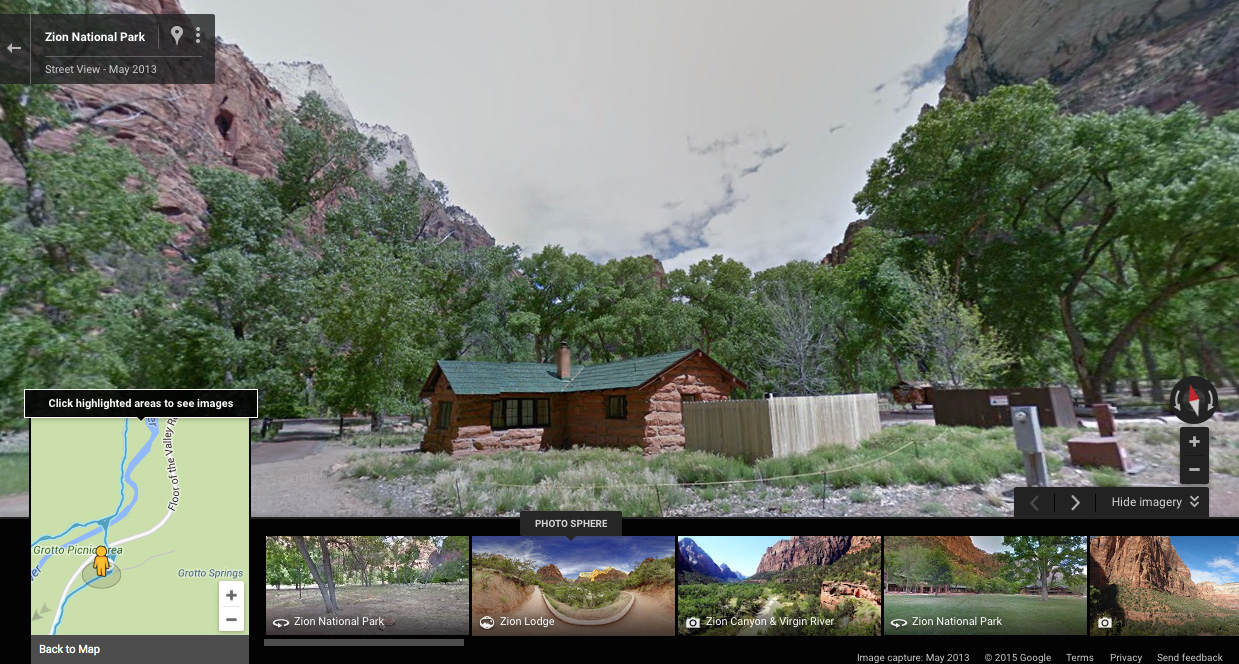
the Grotto House, Zion NP, seen from the S side looking N

Wilderness adventures are a blast (and, yes, the canyon floor can get crowded at Zion National Park, but 90% of the park is wilderness with nary a crowd in sight.) But venturing far from home is best done with a bit of planning and preparation; after all, I don't want to get get all set up to do a light study of Angel's Landing and then discover I've left my brushes in Texas. If possible, I also want to avoid waste time during my adventure in Zion -- scouting out picturesque venues, determining compass coordinates, identifying nearby geological formations that might cast shadows (good or bad), and determining the best time(s) of day to get the most dramatic light effects.


the Grotto House -- viewed from the E looking W (above), and viewed from NNE looking SSW (below)

(I'm already thinking that, if I move a little to the right from this point, I might 
get a nice vertical image -- or two -- of house and canyon wall)


In the past, before visiting a new location, I would have read books and blog posts, looked at magazine articles and, if possible, contacted other artists who had already visited the location -- and I've done that again this year. But this year, thanks to Google, I've got a really neat new tool: Google Street Views!

Google Street View lets me "walk" the trail between Zion Lodge and the Watchman campgrounds, look in all directions, 
test potential compositions (see red box), and determine best time of day to get the optimum lighting effect 

Sure, you say, street views have been available for years on Google maps. But now there's so much more. (In fact, I don't doubt that a name change will soon be in order.) Now Google offers off-road views of trails in major parks and other sights of cultural or historical significance around the globe -- including some of the most popular trails in Zion National Park. And, thanks to the 360º feature, I can even scout for landscape subjects (try out composition options, and determine their compass heading from a particular point on the trail) before I even leave home (which, of course, means that I can start sketching and painting that much quicker once I arrive.) That's cool!


Walter's Wiggles, looking up trail (above) and, wow!, down trail (below) -- now this I'll have to draw, 
paint, video tape... or all of the above (my thanks to Ryan Allison for sharing this with the Google community)


Friday, September 11, 2015

Comp Hunting: How I Learned to Stop Multitasking... and Have More Fun (Zion Prep Update 4.0)

thumbnail comp on grid paper, Bloc Rhodia No. 13

Multitasking is an all-to-common component in the modern workplace (even though studies have shown that it is not an effective time-saver and frequently results in errors.) Unfortunately, multitasking is the way we often approach art-making too -- trying to resolve the problems of composition, pictorial space, tonality, color, and even trying to capture our own emotional reaction to our subject all at the same time. And this, in turn can lead to frustration, misperception, misrepresentation, and even imagery that falls far short of our desired goals.

I personally do not enjoy racing the clock; I find it stressful and even disruptive to the creative process. But our revolving planet stands still for no man and even the most sublime lighting effect is fleeting. So, before a new adventure gets underway, I train hard to work quickly, and search for creative options that enable me to see more clearly, work boldly, and avoid time-consuming errors (both perceptual and technical.)

identifying shapes and tones, Bloc Rhodia No. 13

There are a number of ways of avoiding the stress and inefficiency of multitasking but I have found one that works pretty well for me (and has worked well for other artists too.) I simply break the complex, multifaceted process of creating an image into component parts -- resolving one "visual problem" (or small group of problems) before moving on to the other problem(s) involved in the art making process.

The first "visual problems" I focus on when painting plein air is deciding on a composition, identifying major shapes and spacial plains (background, middle ground, and foreground), and establishing the shadow/highlight patterns that give the subject the appearance of form and record the specific time of day. (At this stage I deliberately ignore color and atmospheric perspective.)

emphasizing plains, Bloc Rhodia No. 12

I begin by viewing the subject through my View Catcher composing tool -- moving the tool side to side, up and down, and forward and backward until I find the composition I'm happiest with. Then I use a graphite pencil (easy to correct and ideal for recording tone through simple changes in pressure) on Rhodia gridded paper to capture the composition while exploring the primary shapes, spacial plains, and patterns of sunlight and shadows of my subject.

To further sharpen this skill I sometimes go out "comp hunting" -- taking with me nothing more than a sketch bag filled with Rhodia grid pads, pencils, eraser, and View Catcher and, in the course of just an hour or two, record several strong compositional studies.  

the light blue grid is both easy to read and readily distinguishable 
from the thumbnail comp, Bloc Rhodia No. 13

In this way I develop an accurate understanding of the non-color aspects of my subject before I pick up my paint brushes. I build self-confidence through successful firsthand experience, and learn to see more clearly -- emphasizing the essential and eliminating the superfluous.

Then, when I am ready to begin applying paint to panel, I am free to focus on the next set of issues -- including the expressive use color and the creation of atmospheric perspective. (And, best of all, I find that I work faster, make fewer mistakes, and have more fun.)

If you think this method might be useful for you, why not give it a try? (And be sure to let me know if you have more fun too.)

Cheers! 


Monday, August 31, 2015

That's So Kawaii!!! (Shopping for Art Supplies at the 100 Yen Store)

This week my wife and kids talked me into taking a break from my Utah prep for a little fun and history-in-the-making all wrapped up into one. What could possibly pry me away from the packing and sketching and painting, you ask? Well, the Daiso chain of 100 Yen stores (which already have an extensive presence in California and Washington state) just opened their first Texas store in the DFW area (Carrollton) and we were off to the grand opening!

the Daiso store is one of the first shops to open for business in the new asian market

My wife and kids wanted to check out the colorful, kawaii (i.e., "cute") goodies and the yummy Japanese snack items; while I was intent on discovering anything that might be useful in the studio or field sketcher's day bag. And very best of all -- almost everything in the store sells for just 100 Yen! (That's $1.50US for those of us who don't carry yen in our wallets.)

every aisle is chock full of colorful little possibilities! 

OK, opting for a hand basket instead of a shopping cart was probably wishful thinking on my part. But, being our first visit, I wasn't really certain how extensive the product range was going to be. (After all "all items $1.50" and "artist's supplies" don't usually go together. Right?) And, besides, my wife and kids each grabbed a basket as we entered too.

need a daypack-sized brush carrier (with water bottle and bulb syringe thrown in for good measure)?

The art supplies weren't difficult to find at all. In fact, I was rather surprised to find that there were aisles of them. Not surprisingly, there was an extensive sumi-e selection. But there was also several small watercolor sets to choose from... and sketchbooks, correction tape, and two-sided adhesive dispensers (colorfully decorated, of course.) 

ink sticks, stones and mini sets (yellow arrows), a selection of traditional 
sumi-e brushes (red arrow), and oriental papers (blue arrow)

I also found at least two artist's sketchbooks in the store's stationary section, and several excellent -- and highly affordable -- ink dish and water bowl options in both plastic "lacquerware" and blue ware  porcelain. (Yep, still just $1.50US.)

leave it to Daiso to make correcting those sketchbook errors whimsical and fun

Some items weren't exactly intended for artists -- but it didn't take much imagination to repurpose them for studio or field work. (For example, if you don't want to risk loosing all those artistic goodies in the tall grass, one of these brightly colored bags might be just the thing for keeping it together.)

now that's kawaii!

Or maybe you like to work with your French color box and tripod stool at home but need to protect your hardwood floors against scrapes and scratches. Well, how about socks for those tripod legs?

OK, I guess you could use these with household furniture too

So, why not check out the Daiso web sight, find the nearest store to you, and pay them a visit? (Or email them and ask when you might be able to expect a store opening in your area.) You're certain to have a fun time.

Don't live in the United States or Japan? No worries! Daiso stores can also be found in North America, Brazil, Asia, Oceania, and the Middle East.

how close is your nearest Daiso store?

Note: Daiso does have an online store on their website, but currently it only sells bulk (i.e., by the case.) The prices are still reasonable, but you probably won't need that many of anything unless you're opening up your own 100 Yen store.)

Next week we're back to adventure prep. (This time we'll be working on paper... and maybe shooting a little video.

Until then, Happy Trails... and Sayonara!

Monday, August 24, 2015

Sketching in Oils as Place-based Journaling (Zion Update 3.0 Step-by-Step)

As any plein air artist can attest, sketching outdoors is a race against time. On anything but an overcast day shadows and highlights are fleeting and ever-changing. If I am lucky I may have an hour and thirty minutes, maybe 2 hours, to capture the lighting of a particular time and place. And sometimes -- having just caught sight of a serendipitous, and oh so fleeting, visual moment -- I may have only a tenth of that... or less. 

when Karen Doherty (at Exaclair USA) first introduced me to Bloc Rhodia notebooks I couldn't think of 
practical application for gridded paper; but now that I'm painting plein air again it's become my very 
favorite comp tool (tip: a wide rubber band will hold the folded pages open "gads-free" while painting)

To speed up the painting process I frequently begin with a sketch in pencil or pen -- focusing on rendering the key shapes, shadows and overlapping plains while making mental notes about hue/temperature/intensity options for the background, middle ground and foreground.  

by pre-toning the panel with Gamblin Yellow Ochre I am able to quickly 
establish an accurate sense of the major forms and spacial plains 

After completing the compositional study I start blocking in the shadow areas on a middle-toned panel. (And if, for any reason, the sketching process is disrupted at this point I already have a recognizable, albeit rough, visual -- and far more personal experience -- of this particular time and place.)

detailing and nuance are now added to the middle ground, water and sky

Next I begin to introduce lighter areas (while still reserving my lightest lights for the end -- when my observations are most accurate) and refine the primary shapes.

highlights are introduced into the foreground cliff tops and face

At this stage the painting is still rough -- but I have finalized the composition; finished blocking in the major color and value areas; and have more or less defined background, middle ground and foreground. 

initial detailing in the middle ground

Pacific Cove, 6"x8", Gamblin oils on Ampersand Gessobord

The final stage (the sprint to finish before the original shadow patterns fade into memory) is fine tuning, adding select detailing (some in the middle ground, but primarily in the foreground), and polishing off a few of the rough edges. (Some "roughness" can add a very desirable sense of spontaneity, vigor and vivaciousness to a sketch though. So I avoid overworking the piece by adhering to the 90-120 minute allocation.)

And, if I intend to use the sketch as a study for a larger work in the studio later (or if I just want a more complete record of place, time and experience) I will frequently make notes -- about the weather, time of day, season, and the sights, sounds and smells of the local, even what I was thinking and feeling at that particular moment -- in white Gelly Roll pen on the back of the panel.
    

Monday, August 17, 2015

The Fresh AiR Gazette

If you're like me you do your best to get as art out of your art adventures as possible. Before each voyage of discovery I spend weeks, sometimes months, establishing a daily routine of observing, sketching and painting -- of artistically living in the moment. When I'm engaged in one of my art adventures I try to experience place as much as possible, and squeeze every sketch, painting and journal entry of the unique local out of the limited time I have. (Of course, sometimes that looks, to the casual observer, like I'm holding a mug of tea staring off into space; but I guarantee the "record" switch is on.)

the layout design for page 1 of the new subscribers-only newsletter

In order to maximize my artistic experience at Zion National Park this year (and produce more artwork to share) I've decided to suspend most of my social media activities -- Facebook, Drawn to Life blog, and most email -- from early October to late November. 

I will stay in touch with my subscribers, however; sharing the latest artworks, trail adventures, journal entries, and links to exclusive preview time laps and step-by-step videos. And I'll do that via my new digital newsletter, The Zion Fresh A-i-R Gazette. Subscribers will receive a new issue of The Gazette each week while I'm on the road and in the park and, if the publication proves a success with readers, Zion will be replaced with the names of other parks as our adventures take us elsewhere in future seasons.

click on either page to view full screen

So, I hope you like the mock-up of Issue #1, and that you share it with friends and family, and (if you'd like to come along on our Zion adventure) that you subscribe. (Then just keep an eye on your inbox and I'll do the rest.)

Cheers! 
_________________________________________________________________________________

New Corporate Partner --

As noted in the test issue of The Fresh A-i-R Gazette, Strathmore Artist Paper has joined the team as my newest sponsor. Strathmore is renowned for their outstanding line of artist papers and journals, and I'll report in detail (including step-by-step field tests and demos) on the papers I'm testing for the Zion adventure in upcoming blog articles.